

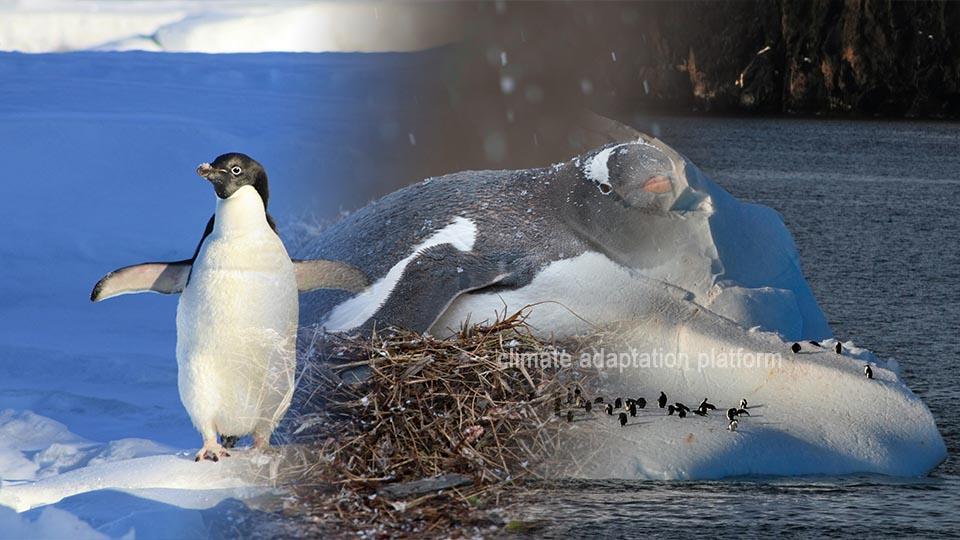
A decade-long study led by Penguin Watch, in collaboration with researchers from the University of Oxford and Oxford Brookes University, reveals that three Antarctic penguin species are rapidly changing their breeding behaviour in response to climate change.
The research focuses on Adélie, Chinstrap, and Gentoo penguins and tracks both their breeding timing and temperature changes across Antarctica over a ten-year period. The findings suggest that all three species are breeding significantly earlier each year as the region warms.
Penguins breeding earlier as Antarctica warms
Published in the Journal of Animal Ecology on 19 January 2026, the study “Record phenological responses to climate change in three sympatric penguin species” examines changes in penguin breeding timing between 2012 and 2022. Researchers analysed when penguins first arrived at breeding colonies, known as “settlement”, defined as the first day individuals occupy a nesting zone.
The study found that penguins breed 10-13 days earlier per decade, representing one of the fastest recorded shifts in breeding phenology among birds. According to the authors, this change coincides with rapid warming along the Western Antarctic Peninsula, one of the fastest-warming regions on Earth.
For seasonal breeders, including many animals and plants, timing, known as phenology, is critical. Successful breeding depends on synchronising reproduction with favourable environmental conditions that maximise offspring survival. Rapid climatic shifts disrupt this delicate balance, forcing species to adapt quickly or risk decline.
Monitoring penguin colonies from space and land
To investigate these changes, researchers deployed 77 time-lapse cameras across 37 penguin colonies on the Antarctic Peninsula and nearby sub-Antarctic islands. This extensive monitoring provided unprecedented insight into breeding behaviour across multiple species while also tracking local temperature changes.
The region has experienced an average temperature increase of around 0.3°C per decade, a rate that poses challenges for penguins adapted to cold and ice-dependent environments.
Among the three species studied, Gentoo penguins showed the most dramatic shift, advancing their breeding by an average of 13 days per decade and up to 24 days in some colonies. This represents the fastest recorded phenological change documented in any bird or vertebrate species to date.
Adélie and Chinstrap penguins also adjusted their breeding schedules, advancing by approximately 10 days on average over the same period.
Winners, losers, and shifting penguin populations
These rapid behavioural changes are creating both winners and losers. Gentoo penguins, which now arrive earlier at breeding sites, are able to temporarily occupy nesting areas traditionally used by Adélie and Chinstrap penguins.
While they are often displaced once the other species arrive, the study warns that continued early breeding could give Gentoos a long-term advantage if they establish active nests before competitors appear.
Gentoo penguins are also more adaptable to climate shifts than the other two species. They have more flexible diets, can survive in ice-free areas during winter, and are less dependent on krill. In contrast, Chinstrap penguins rely heavily on krill, while Adélies prefer colder, ice-prone environments. These ecological differences may accelerate Gentoo expansion as Antarctic conditions continue to change.
Lead author Dr Ignacio Juárez-Martínez warns that declining penguin diversity could have serious consequences. In a press release, he noted that penguins play a crucial role in the Antarctic food web, and losses in diversity increase the risk of broader ecosystem disruption.
Over the past decade, Gentoo populations have increased steadily, with new colonies established across the Antarctic Peninsula, including areas once dominated exclusively by Adélie penguins.
Meanwhile, most Adélie and Chinstrap colonies have declined. Notably, some Adélie colonies in the Weddell Sea remain stable, likely because these areas have experienced less warming and sea-ice loss.
Learn more about the study: Record phenological responses to climate change in three sympatric penguin species.
Source:
Martinez, I. J., Kacelnik, A., Jones, F. M., Hinke, J. T., Dunn, M. J., Rey, A. R., Lynch, H. J., Owen, K., & Hart, T. Record phenological responses to climate change in three sympatric penguin species. Journal of Animal Ecology. https://doi.org/10.1111/1365-2656.70201
A two-week lead in breeding: Antarctic penguins’ striking climate adaptation. (2026, January 20). EurekaAlert! Retrieved from https://www.eurekalert.org/news-releases/1112507?
Leave a Reply