

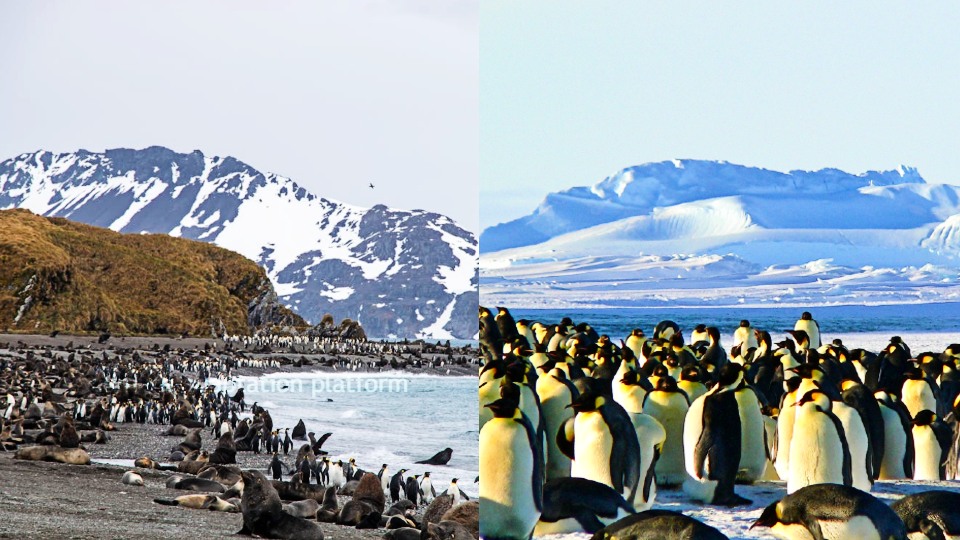
As we grapple with the realities of climate change, few places illustrate its impact more vividly than Antarctica.
The once-thriving ice landscapes, home to the majestic emperor penguin and playful Antarctic fur seals, are vanishing at an alarming rate.
This rapid decline in sea ice not only threatens these iconic species but also serves as a stark reminder of the delicate balance of our planet’s ecosystems.
The IUCN Red List of Threatened Species moved the emperor penguin from Near Threatened to Endangered, while the Antarctic fur seal (Arctocephalus gazella) moved from Least Concern to Endangered.
The IUCN Red List of Threatened Species is a global system for assessing the risk of extinction for plants, animals, and fungi. It serves as an important indicator of biodiversity by tracking species’ conservation status, the threats they face, their distribution, population trends, and the conservation actions required to protect them.
The red list assigns species to categories such as Extinct, Critically Endangered, Endangered, Vulnerable, Near Threatened, and Least Concern based on science-based criteria. The goal is to show which species are at greatest risk and to guide conservation policy and action.
The emperor penguin’s move to the “Endangered” category is due to its declining population. Based on the IUCN’s projections, its population will halve by the 2080s. Satellite images indicate a loss of around 10% of the population between 2009 and 2018 alone, equivalent to more than 20,000 adult penguins.
The primary factor driving the decline in the penguin population is the early breakup and loss of sea ice, which reached a record low in 2016.
Sea ice, especially that attached to the coastline, is crucial for penguins’ survival throughout their lifecycle, including breeding, annual moulting, and hunting for food.
If sea ice disappears too early and rapidly, the chicks do not have enough time to develop waterproof feathers or learn to swim, which can be fatal for them. Additionally, the loss of sea ice disrupts the colony, further contributing to the decrease in their numbers.
Regarding the Antarctic fur seal, its population has also halved from around 2,187,000 mature seals in 1999 to 944,000 in 2025. The warming of the ocean is limiting the availability of their main food, krill, which are moving deeper into colder water.
Other threats include predation by killer whales and leopard seals, and competition from recovering baleen whale populations that also target the same krill.
The southern elephant seal, the largest marine mammal in the world, has been reclassified from “Least Concern” to “Vulnerable” on the IUCN Red List.
Since 2020, the spread of avian flu worldwide has resulted in the deaths of 90% of newborn pups in some colonies and has significantly affected adult females, who tend to spend more time on the beaches than males.
As climate change progresses, the incidence of disease-related deaths among marine mammals is expected to rise, particularly in polar regions where these mammals have less exposure to pathogens.
At the upcoming 48th Antarctic Treaty Consultative Meeting in Hiroshima in May, governments will have an opportunity to act on this newly classified endangered species – the emperor penguin and the Antarctic fur seal.
The meeting gathers governments to oversee and shape environmental protection policy for the Antarctic. BirdLife International contributes by providing the Red List assessment for the Emperor Penguin to inform decision-making.
Martin Harper, CEO of BirdLife International, says: “Penguins are already among the most threatened birds on Earth. The Emperor Penguin’s move to Endangered is a stark warning: climate change is accelerating the extinction crisis before our eyes. Governments must act now – starting by designating the Emperor Penguin as an Antarctic Specially Protected Species this May.”
The British Antarctic Survey video explains the population risk faced by emperor penguins in Antarctica.
Sources
Emperor penguin and Antarctic fur seal now Endangered due to climate change – IUCN Red List. (2026, April 9). IUCN. Retrieved from https://iucn.org/press-release/202604/emperor-penguin-and-antarctic-fur-seal-now-endangered-due-climate-change-iucn
Emperor Penguin now Endangered due to climate change. (2026, April 9). Bird Life International. Retrieved from https://www.birdlife.org/news/2026/04/09/emperor-penguin-now-endangered-due-to-climate-change/
Emperor penguin and Antarctic fur seal now Endangered due to climate change – IUCN Red List. (2026, April 9). British Antarctic Survey. Retrieved from https://www.bas.ac.uk/news/emperor-penguin-and-antarctic-fur-seal-now-endangered-due-to-climate-change-iucn-red-list/
Leave a Reply