

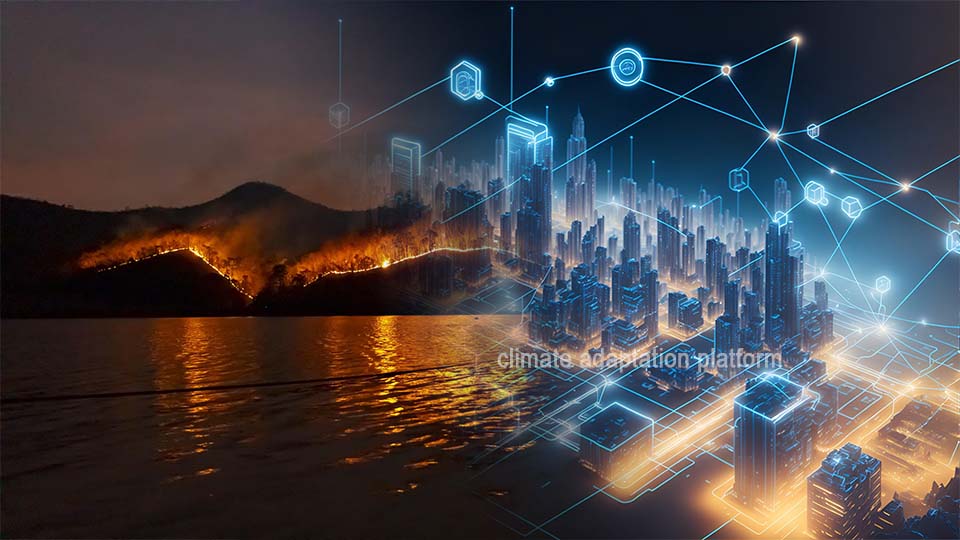
Artificial intelligence (AI) is becoming increasingly prevalent in modern society, integrated across various sectors such as education, healthcare, infrastructure management, urban planning, engineering, agriculture, and entertainment.
The rapid growth of data centre construction, both in the United States and worldwide, is expected to further enhance AI’s capabilities and reach.
AI is particularly valuable in areas that require large-scale data processing, automation, monitoring, and inspection—especially in hazardous environments where human involvement may pose risks.
AI in disaster response and recovery
AI is also playing an increasingly important role in disaster response and recovery. One example is the use of vision–language models (VLMs), which combine computer vision and natural language processing (NLP) to analyse both visual and textual data.
These models can interpret images and videos, generate descriptive text, and respond to natural-language prompts in a visual context.
This form of multimodal AI integrates different types of data—such as text, images, audio, and video—to produce meaningful insights. These outputs can help decision-makers respond more quickly and effectively during emergencies, enabling faster and more informed actions.
The costs and impacts of natural disasters are increasing globally. According to the United Nations Office for Disaster Risk Reduction, the annual cost of disasters is estimated at $202 billion. When considering broader economic and environmental impacts, this figure could rise to as much as $2.3 trillion.
Developing countries bear a disproportionate share of these costs, and climate change is expected to further amplify them. Therefore, investing in resilience has become increasingly crucial for mitigating both economic losses and humanitarian impacts.
New AI tools and the future of resilience
A 2025 study published in the International Journal of Disaster Risk Reduction defines resilience as the speed and quality of recovery following disasters. The study found that recovery times vary widely—from as little as three months to over 20 years—and depend heavily on the type of disaster.
Climate-related events such as floods and storms tend to have faster recovery times than geophysical events like earthquakes and tsunamis.
Traditional disaster response relies heavily on human expertise. However, in high-pressure and hazardous environments, fatigue can impair judgement and slow response times, potentially increasing both human and economic losses.
A 2026 study published in Nature Communications titled “Integration of large vision language models for efficient post-disaster damage assessment and reporting” introduces DisasTeller, a multi-agent LVLM framework that coordinates four specialised “agents” to perform disaster image interpretation, alert generation, emergency analysis, and resource allocation planning.
In a case study of an earthquake in Wajima City, Japan, along with additional flood and bushfire scenarios, DisasTeller demonstrated the ability to complete damage assessments, add map annotations, and generate reports within minutes—tasks that would typically take humans weeks.
Despite its promising capabilities, the study highlights several limitations. One key concern is error propagation, where inaccuracies in early-stage analysis can affect later decisions, such as resource allocation.
As a result, human oversight remains essential for reviewing, refining, and validating AI-generated outputs, particularly in high-stakes situations.
Integrating AI into disaster response shows how advanced technologies are transforming emergency response management.
These tools significantly enhance the speed and efficiency of data analysis, but must be used together with human judgment to ensure accuracy, transparency, and ethical decision-making.
Source:
From billions to trillions: Flagship UN report reveals true cost of disasters and how to reduce them. (2025, May 27). UNDRR. Retrieved from https://www.undrr.org/news/billions-trillions-flagship-un-report-reveals-true-cost-disasters-and-how-reduce-them
Platt, S., Carpenter, O., Mahdavian, F., & Coburn, A. (2025). Disaster recovery – Evidence from 100 natural disasters. International Journal of Disaster Risk Reduction, 129, 105764. https://doi.org/10.1016/j.ijdrr.2025.105764
Caballar, R., & Styker, C. (What are vision language models (VLMs)? (n.d.). IBM. Retrieved from https://www.ibm.com/think/topics/vision-language-models
Integration of large vision language models for efficient post-disaster damage assessment and reporting. (2026, February 3). IKCEST. Retrieved from https://ikcest-drr.data.ac.cn/post/10f9a
Chen, Z., Asadi Shamsabadi, E., Jiang, S., Shen, L., & Dias-da-Costa, D. (2026). Integration of large vision language models for efficient post-disaster damage assessment and reporting. Nature Communications. https://doi.org/10.1038/s41467-025-68216-z
Leave a Reply