

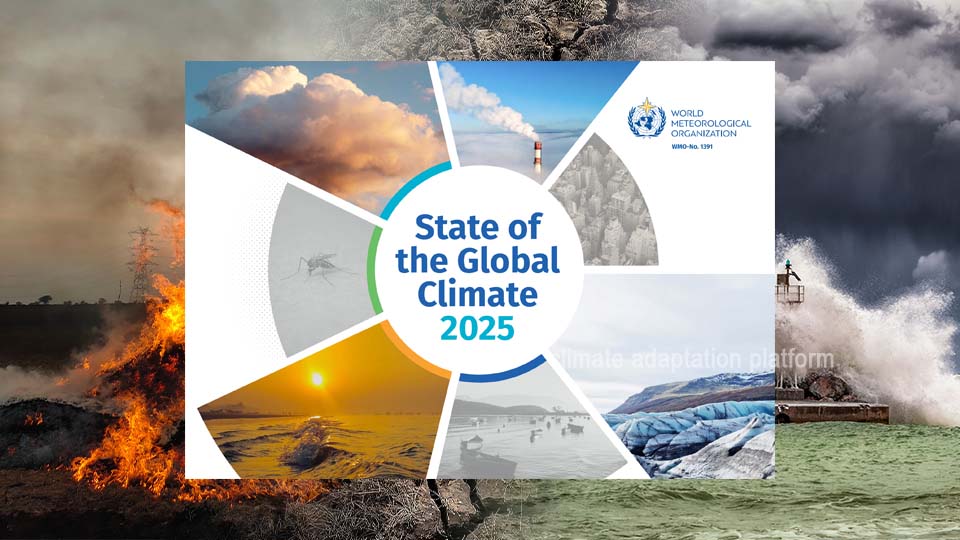
The State of the Global Climate 2025 report, a flagship publication from the World Meteorological Organisation (WMO) published annually since 1993, warns of rapid climate change based on the latest data.
It shows that key climate indicators such as greenhouse gas concentrations, global average temperatures, global mean sea level, ocean heat content, ocean pH, glacier mass balance, sea ice loss, and extreme weather have reached unprecedented or near-record levels.
The report confirms that 2015-2025 were the hottest 11-year period on record, and that 2025 was the second- or third-hottest year on record, at about 1.43°C above the 1850-1900 average. Extreme events around the world, including intense heat, heavy rainfall and tropical cyclones, caused disruption and devastation, highlighting the vulnerability of our interconnected economies and societies.
The big three greenhouse gases: carbon dioxide (CO2), Methane (CH4), and nitrous oxide (N2O) have reached record levels. Carbon dioxide reached 423.9 ± 0.2 ppm, equivalent to 152% of pre-industrial levels; methane reached 1942 ± 2 ppb, equivalent to 266% of pre-industrial levels; and nitrous oxide reached 338.0 ± 0.1 ppb, equivalent to 25% of pre-industrial levels.
As these GHGs trap more heat in the atmosphere, Earth’s energy Imbalance (EEI) is changing. The EEI is the new climate indicator in this year’s report. It notes that since the 1960s the earth’s EEI has been growing, reaching a record high in 2025.
As trapped energy accumulates, it raises temperatures on land and in the ocean, leading to the melting of glaciers and ice sheets. However, temperatures are not rising evenly across the globe, nor are precipitation patterns. Greenland, northern Canada, western Europe, Fennoscandia, the Mediterranean and many parts of Asia experienced significant warm anomalies.
Between 2024 and 2025, glacial mass loss was among the five worst on record since tracking began in 1950. Iceland and North America’s experienced extreme glacier mass loss in 2025.
As the Ocean absorbs the vast majority, or 90%, of the heat trapped in the planet, it raises its temperature, reaching record high levels in 2025, impacting the marine ecosystem, including coral reef bleaching.
Rising ocean temperatures also contribute to sea level rise (SLR) worldwide. As ocean water warms, it expands, and warmer water contributes to the melting of sea ice, dumping more freshwater into the ocean. Both accelerate sea level rise. Satellite records show an increase in SLR from 2.65 mm per year between 1993-2011 to 4.75 mm per year between 2012-2025.
While some may think that a few millimetres of ocean rise is not a big deal, it can have a big impact on coastal flooding and erosion, putting populations at increased risk from storms and floods, saltwater intrusion with cascading impacts to coastal infrastructure, to livelihoods, health, food security, risk of displacement, water security, in the near to long-term.
Risk and Impacts of Climate Change
Rising temperatures significantly affect human health, particularly by increasing the incidence and spread of vector-borne diseases such as dengue.
Changes in rainfall patterns have also influenced breeding sites and population dynamics, expanding risk into new regions and lengthening transmission seasons in areas where dengue is already endemic. Data from the WHO show that about half of the world’s population is at risk of dengue, and current case numbers are the highest on record.
Extreme weather events such as floods, droughts, and strong storms affect food production, including crops and livestock.
To address the impacts of climate change, early warning systems are crucial – they give people time to prepare, alert them to hazardous weather, and inform governments and communities about how to reduce impacts. However, a third of the world’s population, mainly in least developed countries, lacks early warning systems.
UN Secretary-General António Guterres has tasked the World Meteorological Organisation and the Office for Disaster Risk Reduction with leading the effort to ensure that early warning systems protect every person on Earth within five years.
Access the full report: State of the Global Climate 2025
View the State of the Global Climate 2025 Story Maps.
Sources
State of the Global Climate 2025. (23 March 2026). World Meteorological Organisation. Retrieved from https://wmo.int/publication-series/state-of-global-climate/state-of-global-climate-2025
State of the Climate 2025. (2026). World Meteorological Organisation. Retrieved from https://storymaps.arcgis.com/stories/4d50eeb069354888b0ccba346b141c6d
Leave a Reply