

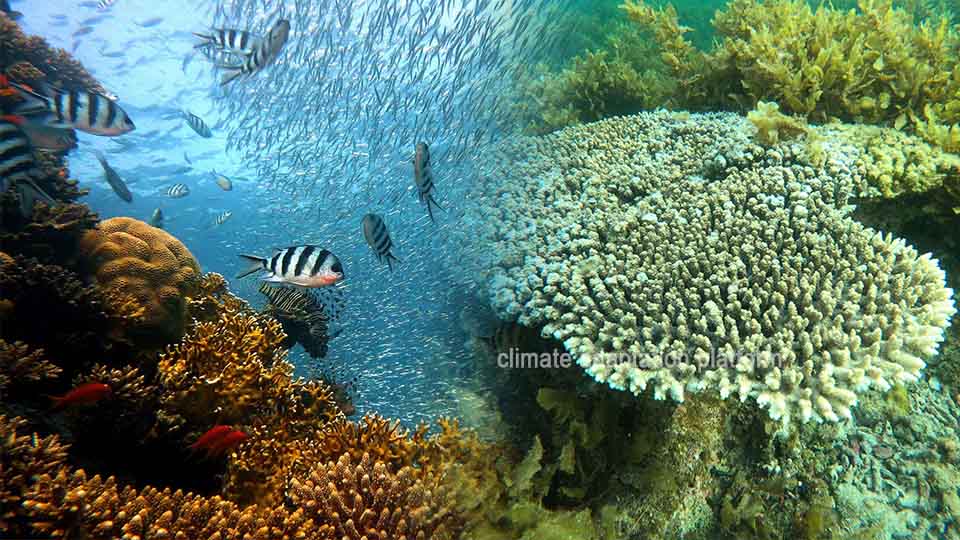
The National Oceanic and Atmospheric Administration (NOAA) announced that the world has experienced its fourth global coral bleaching event, the largest so far, affecting 84% of the world’s coral reef areas and documented in at least 83 countries.
Global coral bleaching continued until NOAA’s last update in December 2025. The previous record occurred during the 3rd coral bleaching event between 2014 and 2017, which affected 68% of the world’s reef areas; the first and second events occurred in 1998 and 2010, respectively.
Climate change poses one of the biggest threats to coral reefs worldwide, and it impacts coral reef ecosystems in two specific ways,s according to NOAA.
First, the warming of the Earth’s atmosphere and oceans due to GHG emissions leads to mass coral bleaching events and increases the frequency of coral infectious disease outbreaks. Coral diseases generally occur in response to biological stressors, such as bacteria, fungi, algae, and viruses, as well as non-biological stressors, like increased water temperatures, ultraviolet radiation, and pollutants. One type of stress may exacerbate another.
Second, the increase in the acidification of the ocean as it absorbs carbon dioxide from the atmosphere. The ocean absorbs 30% of all carbon dioxide emissions and captures 90% of the excess heat generated by these emissions. An increase in ocean CO2 absorption, a process known as ocean acidification. This reduces calcification rates in reef-building organisms, making their skeletons weaker and more prone to erosion as they face the dual challenges of a warming ocean and ocean acidification.
Heat-resistant corals
Corals are highly sensitive organisms and require specific conditions to survive; failing to meet these conditions can lead to their deterioration or death. According to the Coral Reef Alliance, corals prefer water temperatures that range between 73° and 84° Fahrenheit or 23° and 29° Celsius.
Some species can tolerate temperatures as low as 68° F (20° C) and as high as 90° F (32° C). Corals also need pollution-free water. A tiny alga called zooxanthellae lives inside them and provides them with food for reef building. But murky waters or pollution can shield sunlight from zooxanthellae, depriving corals of their food source.
Significance of coral reefs
Coral reefs offer many life-sustaining and economic goods and services. Among these benefits are supporting a quarter of word’s marine life, including 4,000 species of fish, corals, and other marine life, while covering just 1% of the world’s oceans.
Healthy coral reefs provide food for coastal and inland communities and support jobs and businesses through tourism and recreation.
The ecosystems that coral reefs support are also critical for developing new medicines to treat cancer and other diseases, and experts believe coral reefs still offer substantial untapped potential.
Coral reefs also protect shorelines by reducing the impact of waves, storms, and floods. This helps prevent loss of life, property damage, and erosion.
An article in The Conversation highlights research from authors at universities and institutions around the world on how to help coral reefs adapt to a warming ocean.
According to the article, there are naturally heat-resistant corals that can survive in water temperatures up to 36°C. These corals are found in the warm water of the Pacific Ocean and the Persian Gulf. Scientists are turning their attention to these thermally acclimated corals to discover how they could help save the declining reefs.
Assisting corals adapt to climate change
A review by researchers from universities and institutions worldwide, published in Nature Reviews Earth & Environment in February 2026, found that some reefs may survive if corals become more heat-tolerant.
A co-author of the review, Christopher Cornwall, a lecturer in marine biology at New Zealand’s Te Herenga Waka-Victoria University of Wellington, says that coral restoration must be carried out at scale, using heat-tolerant corals to ensure their survival.
Humans can assist in coral restoration by breeding heat-tolerant corals, a form of assisted evolution. Human intervention can accelerate the natural process, helping coral respond to and recover from heat and other stressors caused by climate change.
A study published in Current Biology, examining how assisted evolution interventions like breeding and trait selection work, found that for these interventions to be successful, they would require “extremely strong selection.”
A co-author of the study, who specialises in coral reef ecosystems and researches coral in Palau, says that variability within and among reefs and coral species must be considered when developing more heat-resistant corals, which complicates replication. “Even within a single reef, there’s a range of tolerance levels,” he said.
Other interventions from researchers at the Australian Institute of Marine Science (AIMS) include introducing beneficial bacteria into corals to improve their heat tolerance and interbreeding wild colonies of the same coral species so that heat tolerance can be passed down. Heat-resistant coral species include some Pocillopora and Acropora.
While research and development can help corals adapt to a warming climate, it is also essential to address the root causes of ocean warming and acidification, which drive mass coral bleaching worldwide.
Sources
How does climate change affect coral reefs? (2024, June 16). NOAA National Ocean Service. Retrieved from https://oceanservice.noaa.gov/facts/coralreef-climate.html
The ocean – the world’s greatest ally against climate change. (n.d.). United Nations. Retrieved from https://www.un.org/en/climatechange/science/climate-issues/ocean.
What Do Corals Reefs Need to Survive? (2026). Coral Reef Alliance. Retrieved from https://coral.org/en/coral-reefs-101/what-do-corals-reefs-need-to-survive/
Why are coral reefs important? (2024, December 12). NOAA. Retrieved from https://oceanservice.noaa.gov/education/tutorial_corals/coral07_importance.html
Current Global Bleaching: Status Update & Data Submission. (2025, December 4). Coral Reef Watch. Retrieved from https://www.coralreefwatch.noaa.gov/satellite/research/coral_bleaching_report.php
Isenhower, W. (2026 May 6). Heat‑resistant corals could help reefs adapt to climate change. The Conversation. Retrieved from https://theconversation.com/heat-resistant-corals-could-help-reefs-adapt-to-climate-change-279508
Leave a Reply