

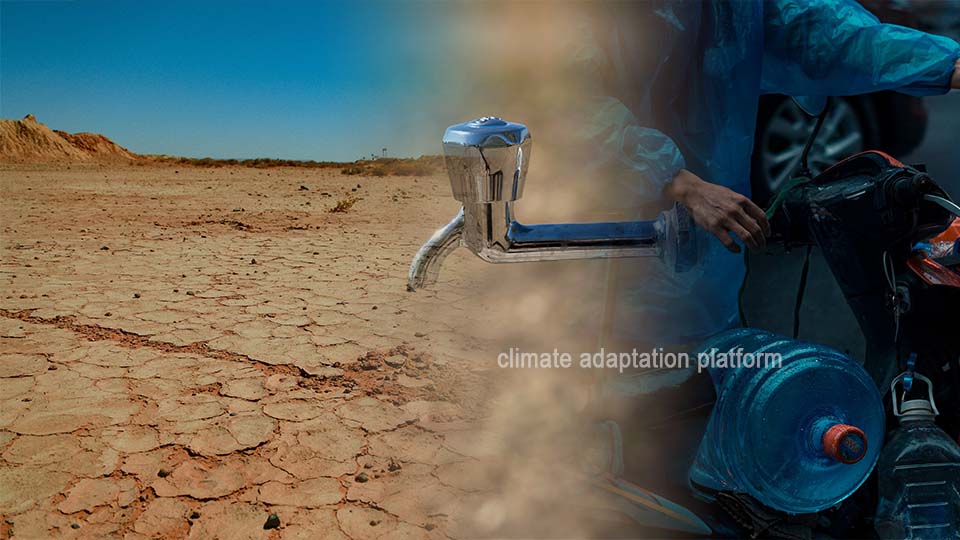
Rapidly growing cities face water security challenges due to rising demand and limited freshwater supplies. Extreme droughts and water shortages have impacted more than 80 big cities since 2000. By mid-century, it is projected that 33-50% of the world’s cities will face water scarcity, with a quarter of this population living in India.
The recent water crisis that gripped cities like Cape Town, São Paulo, and Chennai shows how droughts can worsen existing inequalities in access to freshwater supplies and water infrastructure, disproportionately impacting low-income communities and informal settlements.
The crisis has also highlighted that water insecurity is not only a problem of limited water supplies but also an outcome of multiple converging factors, such as local water cycles, socio-economic dynamics, and policies and governance in water management and distribution.
The study, “Drought-Driven Water Insecurity in an Emerging Indian Megacity: A Coupled Multi-Agent Systems Approach for Policy Evaluation”, published in Earth’s Future journal in March 2026, explores the water security in Pune, India, in the future, where the city is seeing a rapid population growth projected to reach between 7 and 11 million by 2050.
Pune has an aging water supply system, more than a million informal settlers without plumbing, and is prone to multi-year droughts. Additionally, there is growing tension between rising water demands from urban users and those of the agricultural sector, dominated by water-thirsty sugarcane crops.
It finds that if Pune continues current policies, there is a good chance its reservoirs and groundwater levels will dry up, impacting the poor and those living in informal settlements. Specifically, the cost of water can take up to 20% of their income, even with reduced access to water.
The research uses a sophisticated “multi-agent systems” model to simulate how individual households, businesses, and government policies interact with the natural environment during long-term drought, to evaluate how different policy interventions could protect residents, especially in informal settlements, from severe water shortages.
The study finds that even when a city implements comprehensive reforms, such as improving infrastructure by fixing leaks, reducing or eliminating water theft, increasing water prices for heavy users, capping groundwater extraction, or doubling electricity costs for groundwater pumping, these actions primarily benefit middle- and high-income households.
Unfortunately, they only slightly improve water affordability for the poorest households. Even reallocating water from a major dam would not significantly change this situation on its own.
The study notes that the biggest impact on providing water to the poorest households would be to reallocate water from agriculture to urban households. This entails establishing a regulated market in which farms can sell irrigation water to the lowest 10% of the population, or to low-income residents in informal settlements.
The study’s findings show that their model effectively monitors the close link between water shortages and socio-economic inequality. The poorest and those living in informal settlements will face greater water stress than those in middle- and higher-income areas or households.
Although the study is based in Pune, India, the study’s modelling and framework are transferable to other rapidly growing cities in the Global South facing similar challenges.
Learn more about the study: Drought-Driven Water Insecurity in an Emerging Indian Megacity: A Coupled Multi-Agent Systems Approach for Policy Evaluation
Sources
Wang, A., A. Klassert, C. J., Karutz, R., Smilovic, M., Kahil, T., Burek, P., Zhu, Y., Zozmann, H., Klauer, B., Küblböck, K., Omann, I., Figueroa, A. J., Wada, Y., Naylor, R., & Gorelick, S. M. (2026). Drought-Driven Water Insecurity in an Emerging Indian Megacity: A Coupled Multi-Agent Systems Approach for Policy Evaluation. Earth’s Future, 14(3), e2025EF007976. https://doi.org/10.1029/2025EF007976
Garthwaite, J. (2026, March 10). New research shows path to affordable water in fast-growing cities. Stanford University. Retrieved from https://sustainability.stanford.edu/news/new-research-shows-path-affordable-water-fast-growing-cities
Leave a Reply