

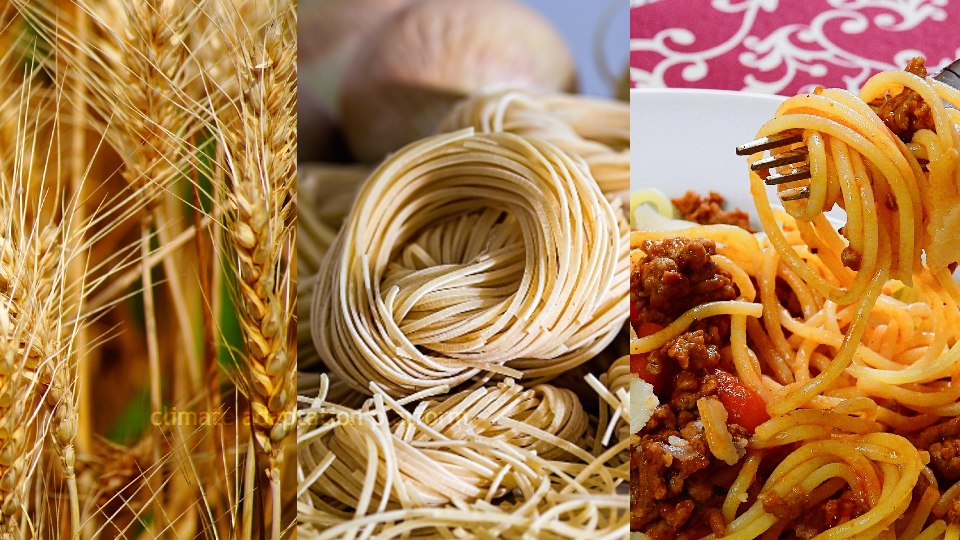
Durum wheat (Triticum turgidum subsp. Durum) is often called pasta or macaroni wheat. Its name, durum, means “hard”, referring to its dense, vitreous kernel, which is crucial for making high-quality pasta, in contrast to the common wheat (Triticum aestivum), which dominates global bread production.
Durum wheat, cultivated primarily in the Mediterranean, North America (particularly Canada), and parts of India, plays a significant role in providing food security and nutrition for millions of people worldwide.
Aside from pasta, durum wheat is used to make traditional staples, such as couscous, pizza crust, baklava, and unleavened breads.
It also has higher levels of protein, minerals- especially selenium, vitamins -especially vitamin B-complex and vitamin E, and carotenoid pigments which offer antioxidants and anticancer properties, compared to bread wheat.
Durum wheat, like other crops, is also vulnerable to the effects of climate change, including higher temperatures, more frequent and longer droughts, and increased pest and disease pressure, especially in the Mediterranean region and sub-Saharan Africa.
Key diseases in wheat include leaf rust and yellow rust, septoria leaf blotch, head blight (scab), and root rot, which are common in North Africa. The Hessian fly is also emerging as an increasingly important insect pest, causing extensive damage to cereal production in North Africa, West Asia, and Central Asia.
As climate change raises temperatures and alters precipitation patterns, it is becoming increasingly difficult to maintain consistent wheat yields. Breeding programs have mainly aimed at selecting crop varieties that maximise yield.
However, progress has been slow because selecting high-yielding varieties under ideal conditions does not always translate into good performance under environmental stress. This situation reveals a trade-off between achieving maximum productivity and ensuring yield stability.
The growing predictability of climate conditions calls for a shift from focusing solely on high yield to prioritising crop stability when choosing which wheat to propagate.
Yield stability in wheat is complex and controlled by many genes, as well as by plant traits such as phenology, canopy structure, biomass, and the efficiency with which plants use water and nutrients.
The traditional approach to determining crop stability relies on evaluating genotype yield performance across contrasting environments. Varieties that change little across environments are considered stable, while others are highly sensitive to either favourable or unfavourable conditions.
However, this approach is costly and labour-intensive. A more efficient and cost-effective approach is to use high-throughput phenotyping (HTP) techniques to estimate yield by measuring plant traits without harvesting.
HTP uses automated sensors, cameras, and imaging technologies to quickly measure plant traits such as growth, stress responses, and yield potential at scale. Although remote sensing is widely used to estimate yield, its use for assessing yield stability is still emerging.
The study titled “Multi-sensor Phenotyping of Yield and Yield Stability for Genotype Selection in Durum Wheat” assessed 64 elite durum wheat varieties across two Mediterranean locations in Spain, one irrigated and one rainfed.
The research utilised ground-based and drone-mounted sensors—including RGB, multispectral, and thermal-infrared—to monitor key traits such as canopy greenness, temperature, chlorophyll levels, and senescence at critical growth stages, including anthesis (flowering) and grain filling. The objective was to identify wheat varieties that are capable of withstanding the unpredictable weather patterns associated with climate change.
The study used a statistical model to calculate yield and yield stability across sites, based on how yields responded to environmental differences. Varieties were grouped using standard thresholds: those with low yield or low stability were labelled “discard,” while others with decent yield and stability were “keep” candidates for breeding.
Their findings show that “keep” varieties showed strong early growth but senesced (turned yellow) earlier by the end of grain filling. Poor “discard” ones had weak starts and held onto greenness too long, a “stay-green” trait that hurt performance, a finding that challenges a common belief in farming that crops that stay green longer produce higher yields.
Instead, the study reveals that the most successful climate-resilient varieties in their study area displayed two specific traits: high initial vigour and early maturation.
Wheat varieties that grow rapidly and strongly at the beginning of the season, and mature early, allowing them to escape the most intense heat and droughts that often occur late in the Mediterranean summer.
The study’s findings suggest that breeding should prioritise timely senescence over extended greenness for climate resilience, as this is better suited to dry, water-scarce regions. This pattern emerged from drone and sensor data analysed across irrigated and rainfed trials.
Sources
Jauregui-Besó, J., Aparicio, N., Álvarez, S., Nieto-Taladriz, M. T., Araus, J. L., & Kefauver, S. C. (2026). Multi-sensor phenotyping of yield and yield stability for genotype selection in durum wheat. Plant Phenomics, 8(1), 100178. https://doi.org/10.1016/j.plaphe.2026.100178
AI and drones team up to find climate-resilient wheat. (2026, April 13). Open Access Government. Retrieved from https://www.openaccessgovernment.org/ai-and-drones-team-up-to-find-climate-resilient-wheat/207986/
Leave a Reply