

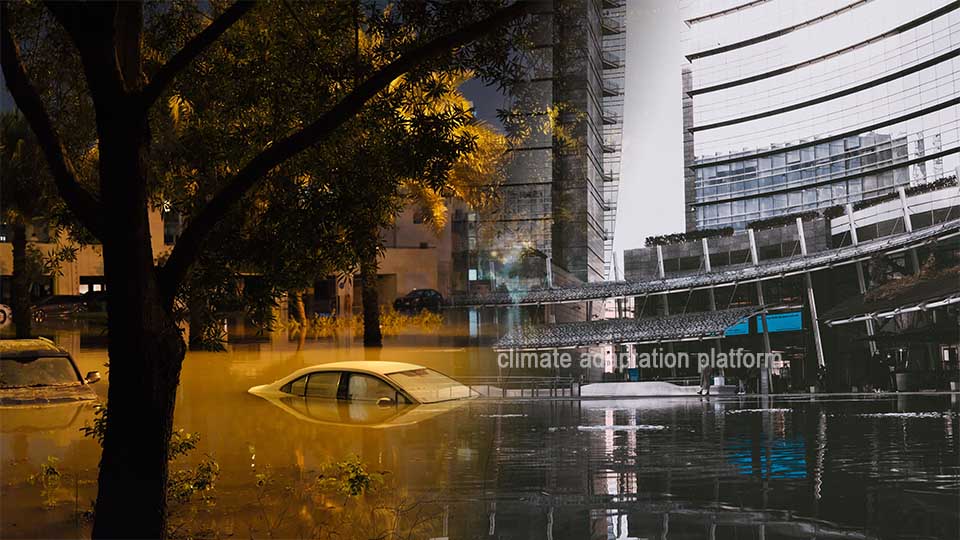
According to NOAA, global mean sea levels have risen by 8 to 9 inches (21-24 cm) since 1880. Melting glaciers and ice sheets, and the thermal expansion of the ocean as it warms, are the main causes of rising sea levels.
This accelerated sea level rise poses a serious threat to low-lying coastal areas. Understanding the dynamics and causes of sea level rise (SLR) is essential for predicting future sea level changes and planning climate adaptation and mitigation strategies.
A study published in Science Advances, “Improved closure of the global mean sea level budget from observational advances since 1960”, on 20 May 2026, reveals a sudden acceleration in global sea levels in 2012 and a continued acceleration since then. According to the study, global sea levels have risen at an average rate of 2.06 millimetres per year since 1960.
However, the speed has significantly increased in recent decades. Between 1993 and 2023, the pace increased to an average of 3.41 mm per year, and between 2005 and 2023, it rose to 3.94 mm per year.
The doubling of sea level rise in recent decades is attributed to ocean warming, which accounts for 43% of the increase as warmer water expands and takes up space.
Glacier melting in Greenland and the Antarctic is also a main driver of land water storage – as people withdraw water from underground, aquifers, lakes, and rivers, the water eventually drains into the ocean, adding more water to it.
The study, authored by an international team of climate researchers from the Institute of Atmospheric Physics at the Chinese Academy of Sciences, researchers from Tulane University, the NSF National Centre for Atmospheric Research, the University of St. Thomas, and scientific partners in France, revisited the sea level rise during the three different time periods 1960–2023, 1993–2023, and 2005–2023.
Earlier assessments, such as the IPCC AR6, have highlighted a significant discrepancy between observed sea level rise and the combined estimates from known causes. These causes include ocean warming, glacier melt, losses from Greenland and Antarctic ice, and changes in land water storage.
However, advancements in global observation systems—such as satellite altimetry, satellite gravimetry, and Argo floats—have allowed researchers to narrow this gap.
They have successfully reconciled the global mean sea level (GMSL) budget, meaning that scientists can now account for the observed rise in global sea levels by totalling the main known contributors, and this total aligns with the measured rise within the margins of uncertainty.
As sea level rise is expected to continue for hundreds of years, researchers argue that better data now allows scientists to explain it with greater confidence.
Sources
Zheng, H., Cheng, L., Dangendorf, S., Meyssignac, B., Barnoud, A., Trenberth, K. E., Fasullo, J. T., & Abraham, J. (2026). Improved closure of the global mean sea level budget from observational advances since 1960. Science Advances. https://doi.org/aea0652
Linsey, R. (2023, August 22). Climate Change: Global Sea Level. NOAA. Retrieved from https://www.climate.gov/news-features/understanding-climate/climate-change-global-sea-level
Sea level rise is speeding up, and scientists now know exactly why. (2026, May 22). Science Daily. Retrieved from https://www.sciencedaily.com/releases/2026/05/260522023116.htm
Leave a Reply