

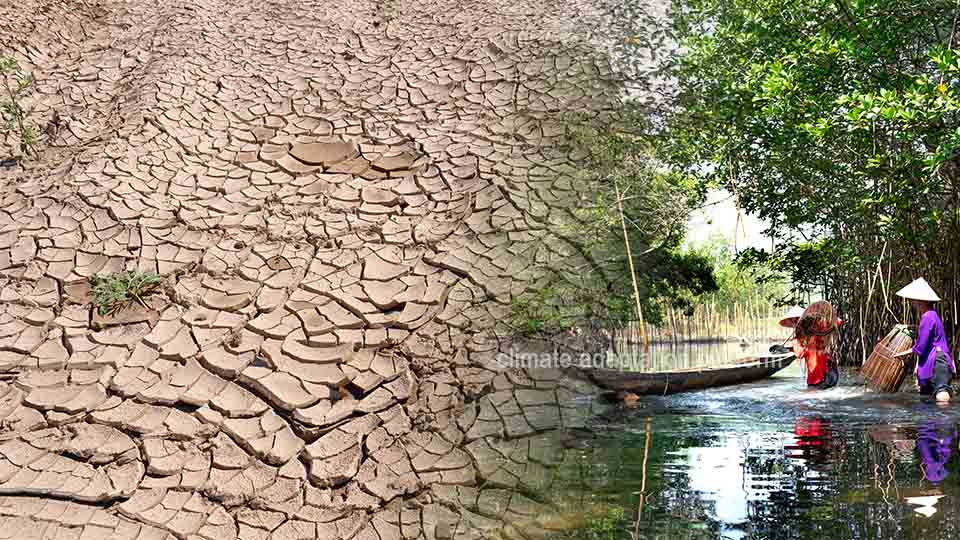
Communities affected by armed conflict are also vulnerable to climate change and extreme weather events because they lack the capacity to adapt and mitigate these impacts.
Conflicts lead to forced displacements, the destruction of infrastructure, the loss of livelihoods and access to food and drinking water, causing economic and social instability.
Understanding the interactions between climate change adaptation and peacebuilding is key to responding to climate–conflict dynamics and enabling responsible scaling of interventions. Climate change adaptation and peacebuilding interventions focus on building capacities to prepare for and minimise the impacts of climate change and conflict.
However, climate adaptation and peacebuilding interventions are not integrated and are usually implemented in sectoral silos; as a result, efforts are often duplicated, leading to missed opportunities and inefficiencies. Worse, it can lead to maladaptive outcomes, whereby adaptation and peacebuilding interventions increase or redistribute communities’ vulnerabilities.
The study, “Integrating climate adaptation and peacebuilding: capacity development in climate and conflict-affected communities,” published in 2026 in the journal Global Environmental Change, identifies some of the overlaps between climate change adaptation and peacebuilding and explores ways to integrate these areas to respond to cumulative and reinforcing climate change and conflict impacts to support communities that are simultaneously burdened by climate change and armed conflict.
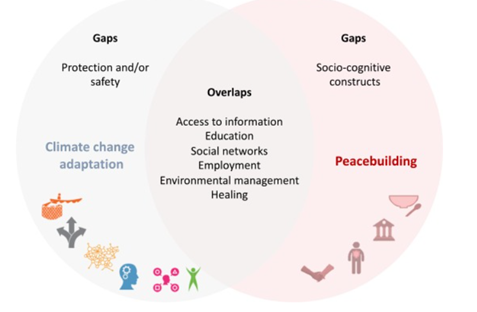
Using an in-depth case study of Cispatá Bay, located in the Caribbean Sea, Colombia, in South America and two data collection methods (interviews and document analysis), the authors found six major areas of overlap between climate change adaptation and peacebuilding: access to information, education, social networks, employment, environment, and healing.
They also identified two gaps: protection and/or safety and socio-cognitive constructs, which could undermine both climate change adaptation and peacebuilding.
The study area, Cispatá Bay, is located on the Caribbean coast of Colombia, in South America. Cispatá Bay covers a 27,000-acre mangrove forest (11,000 hectares) connected to the Sinú River by canals and marshes. The fertile area means that the economy is based on agriculture, livestock and small-scale fishing. Around 90% of the inhabitants are local, with the remaining 10% being displaced individuals from other regions due to Colombia’s armed conflict.
Armed conflict in Colombia began around 1950, when various armed groups started to establish themselves in Cispatá Bay and assert territorial control. This situation led to land dispossession, disruption of social networks, and restricted access to marine fishery resources.
Although the peace agreement signed in 2016 resulted in a reduction of violence and the implementation of several peacebuilding initiatives—such as land restitution, economic compensation, and the reintegration of former combatants into civil society—coastal communities in Cispatá Bay continue to face significant challenges. These challenges include a limited institutional presence, unequal access to state resources, and the resurgence of armed groups competing for control over illicit economies.
These challenges limit the effectiveness of peacebuilding interventions. At the same time, climate change impacts, such as mangrove degradation, coastal erosion, saltwater intrusion, and recurrent flooding, all of which have impacted the main sources of local income, including fishing, aquaculture, and agriculture, place additional strain on the Bay residents.
The coastal community of Cispatá Bay has been participating in climate change adaptation and peacebuilding interventions for over three years, implemented by environmental authorities, local and international NGO foundations, national and local governments, and community-based associations of mangrove farmers.
During the interviews, participants highlighted that these interventions have been effective in reducing social tensions and conflict and helping the community adapt to the impacts of climate change.
Building on these overlaps and gaps, the authors propose a new synergistic framework to integrate climate change adaptation and peacebuilding. The framework consists of 8 determinants to foster capacity building in regions affected by both climate change and conflict: (1) governance and institutions; (2) agency and cognitive processes; (3) employment and livelihood diversification; (4) technological and economic resources; (5) learning; (6) healing; (7) security and justice; and (8) social networks. This helps identify what is most needed locally and which actions are likely to be most effective for advancing both climate adaptation and peacebuilding.
According to the study, the framework provides novel insights into developing climate adaptation and peacebuilding interventions to prevent reinforcing cycles in which conflict increases vulnerability to climate change, and climate change increases the risk of violent conflict.
Using this framework provides an important step to building resilience and peace, thereby preventing maladaptation and the increase and/or redistribution of vulnerabilities.
Learn more about the study by clicking the link in the “Source” section below.
Source
Taborda, L. F. B., Morrison, T. H., & Barnes, M. L. (2026). Integrating climate adaptation and peacebuilding: Capacity development in climate and conflict-affected communities. Global Environmental Change, 98, 103151. https://doi.org/10.1016/j.gloenvcha.2026.103151
Leave a Reply