

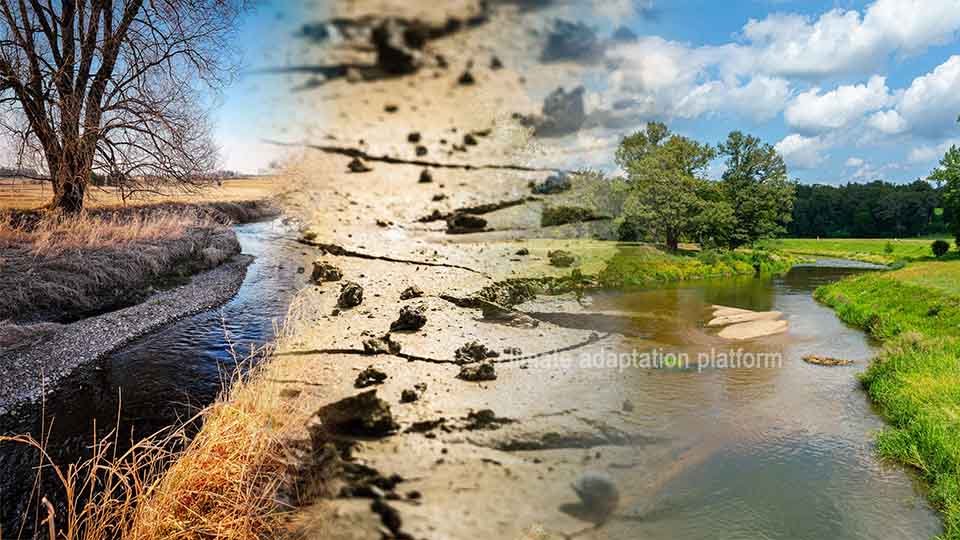
Invasive plant species in South Africa are causing serious problems, especially regarding water. Invasive species are first and foremost water-thirsty – their extensive root systems consume significant amounts of water.
South Africa’s annual rainfall is less than half the global average at just 464 millimetres, making it drought-prone and exacerbating the impacts of invasive species.
The book, “Impacts of Plant Invasions on Terrestrial Water Flows in South Africa”, provides an encyclopaedic overview of all aspects of biological invasions in South Africa, and chronicles the history of introductions, invasions, and the emergence of invasion science in South Africa, and the development of policy and legislation for dealing with invasions, spanning 150 years.
A chapter in the book shows that invasive plant species in South Africa can increase water loss through transpiration and evaporation, reducing river flows by nearly 3%. It examines decades of research on how invasive plants have invaded South Africa’s landscapes and their effects on water flows, covering a wide range of plant types, from shrubs to large trees – species introduced to the country for forest and ornamental use that have since become invasive.
Among the major invasive plants were tree species introduced to South Africa in the last few centuries to address timber shortages, due to the limited extent of natural forests and the lack of fast-growing native tree species suitable for timber.
Soon, landowners downstream of the planted areas noticed the drying up of rivers and streams, who believed the new tree species were the cause of the problem, but were opposed by the foresters.
These concerns increased following a succession of severe droughts in the 1920s, which led to a recommendation for a long-term research programme during the fourth British Empire Forestry Conference in South Africa.
The programme provides unequivocal evidence that tree plantations have indeed reduced runoff relative to the natural vegetation they replaced, a finding supported by numerous catchment-level studies worldwide.
The chapter also distinguishes the effects of water loss between dryland or upland areas with limited rainfall and riparian or groundwater-access areas, such as locations near rivers and floodplains. It finds that the impacts of invasive plants are up to two times greater when they are located in riparian areas or with access to groundwater.
Its effects on water loss depend on its size, rooting depth, and leaf development compared to those of native plants. The areas most affected are the Western, Eastern Cape, and KwaZulu-Natal.
The book warns that water loss will further increase to 50% if no actions are taken to address invasive plant species and highlights the need to know more about their impacts on larger landscapes and catchment areas, and to guide water resource managers in making decisions about which areas to clear and rehabilitate, as well as which species to control.
The WRI article discusses the impacts of invasive plant species on South Africa and the ambitious steps the country is taking to address them. As temperatures rise due to climate change, droughts will become more frequent and severe in South Africa, an already drought-prone country.
Addressing invasive plants supports climate adaptation by strengthening ecosystems, water security, and community resilience against the impacts of climate change. The article features several initiatives implemented in the country that show how.
Working for Water, launched in 1995, removes invasive plants from catchments, rivers and reservoirs and creates thousands of jobs in landscape restoration. Working with the Greater Cape Town Water Fund, the programme has cleared 6,000 hectares of invasive plants since 2023, recovering more than 15 billion litres of water each year for Cape Town’s 5 million residents — equivalent to around two weeks of the drought-prone city’s water supply.
Stewards of Nature, in the Eastern Cape, collaborates with WWF South Africa to develop a Water Impact Calculator to quantify the water recovered through invasive species removal. Using the tool, they find that clearing just 269 hectares of invasive black wattle and Port Jackson freed enough water to serve more than 16,000 households for a year.
SUNCASA project helps Johannesburg’s residents to withstand floods better. Local communities are clearing invasive plants clogging waterways along the Jukskei riverbank. The initiative also helps restore ecosystem health and opens riversides for natural infrastructure such as parks and green buffers.
As climate change raises temperatures, it will lead to the spread of more invasive species, many of which are heat- and drought-tolerant and outcompete native species. When this happens, it will exacerbate the water crisis in South Africa.
Removing invasive plants alone will not solve the problem; hence, South Africa’s strategy is to combine national programs, regional buy-in and local community action, turning an invasive crisis into an opportunity for water supply resilience.
Source
Le Maitre, D.C. et al. (2020). Impacts of Plant Invasions on Terrestrial Water Flows in South Africa. In: van Wilgen, B., Measey, J., Richardson, D., Wilson, J., Zengeya, T. (eds) Biological Invasions in South Africa. Invading Nature – Springer Series in Invasion Ecology, vol 14. Springer, Cham. https://doi.org/10.1007/978-3-030-32394-3_15
Beyer, A., Gcanga, A., & Tekele, E. (2025, November 24). South Africa Is Fighting Back Against Invasive Plants. World Resource Institute. Retrieved from https://www.wri.org/insights/south-africa-fighting-back-against-invasive-plants
Leave a Reply