

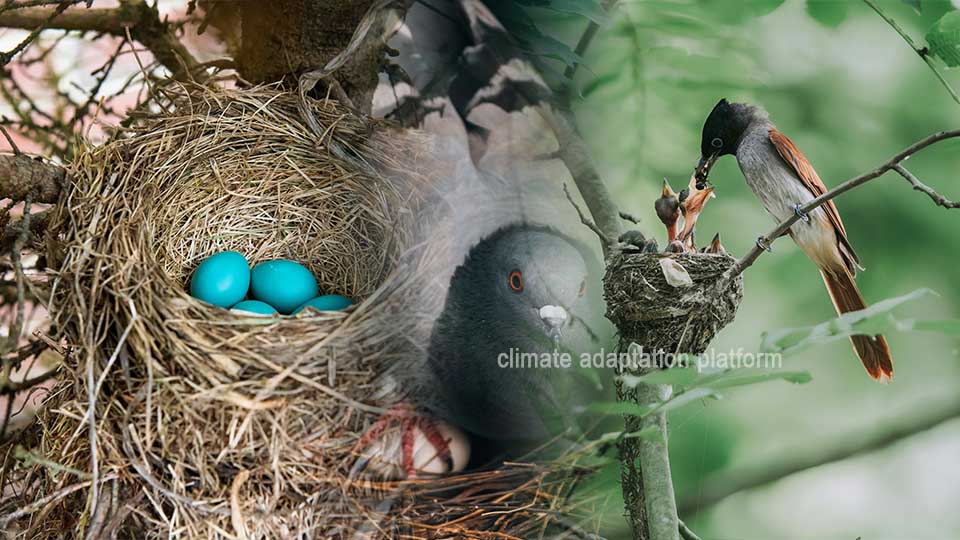
Climate change is affecting the phenology of animals and plants. Phenology is the timing of seasonal and recurring biological events in an animal’s or plant’s life cycle, such as plant flowering, insect emergence, and bird migration, especially their timing and relationships with weather and climate.
A study published in Nature Communications, titled “Changes in phenology mediate vertebrate population responses to temperature globally”, by an international team of scientists, examines whether changes in phenology or the timing of breeding and migration explain how temperature affects animal populations and morphology worldwide.
Researchers collected data from 213 long-term studies that tracked both animal traits (such as body size and breeding timing) and population sizes of wild vertebrates worldwide, including birds and snakes.
They combined this with local temperature and rainfall records to examine how climate affects populations and their morphology (body characteristics). What they find is that animals are changing their habits in response to warming and are also adapting well to climate change.
Of the over 200+ scientific studies analysed, 65% are birds, 23% are reptiles, and 10 are mammals. These studies must have long-term data, spanning 15-25 years, on phenology, morphology, and population sizes, as a basis for selecting them for this meta-analysis, to allow researchers to observe clear patterns.
The 96 relevant phenology studies provide strong evidence that warming temperatures cause changes in the seasonally recurring developmental processes – breeding times and phenological characteristics are occurring earlier, while in some animals, they observe a delay.
This indicates that the effects of temperature on phenology are heterogeneous across animal species, which could be partly explained by their generation time, age at reproduction, diet, migratory mode, and latitudinal location.
Changes in phenology, such as early breeding in animals, have no negative effect on their populations and can even increase them. In other species, changes in phenology- for example, the timing of egg laying- become a climate adaptation response. This shows a plasticity trait in animals, allowing them to adapt to temperature changes.
With regard to the morphology or physical traits of species, such as body size, weight, and limb length, they find that these traits show no correlation with warming temperatures or changing rainfall patterns and are not affecting population changes.
Species near low latitudes or the equator experience weaker temperature effects on phenology, meaning they don’t adjust their breeding timing, which has a direct negative effect on their population.
In contrast, species in higher latitudes, or areas closer to the poles, shift their breeding timing more readily, which helps with their population.
“The effect of warming on phenology is very clear, but the implications for wildlife are heterogeneous,” says Dr. Tom Reed from University College Cork, a shared senior author of the study. “We are probably dealing primarily with so-called trait plasticity and, in the periods studied, not yet with evolutionary processes. Phenological traits can obviously be adapted flexibly enough by animals” (Zwilling, 2026).
Learn more about the study:
Changes in phenology mediate vertebrate population responses to temperature globally.
Source:
Radchuk, V., Jones, C. V., McLean, N., Charmantier, A., Teplitsky, C., Alisauskas, R., Ancona, S., Anker-Nilssen, T., Arcese, P., Arlt, D., Aubry, L. M., Bailey, L., Barbraud, C., Berg, K. S., Berteaux, D., Blumstein, D. T., Bouwhuis, S., Brose, U., Brouwer, L., . . . Reed, T. E. (2026). Changes in phenology mediate vertebrate population responses to temperature globally. Nature Communications, 17(1), 479. https://doi.org/10.1038/s41467-025-68172-8
Zwilling, J. (2026, January 19). Meta-study reveals mechanisms of animals’ adaptations to cope with climate change. Phys.Org. Retrieved from https://phys.org/news/2026-01-meta-reveals-mechanisms-animals-cope.html
Leave a Reply