

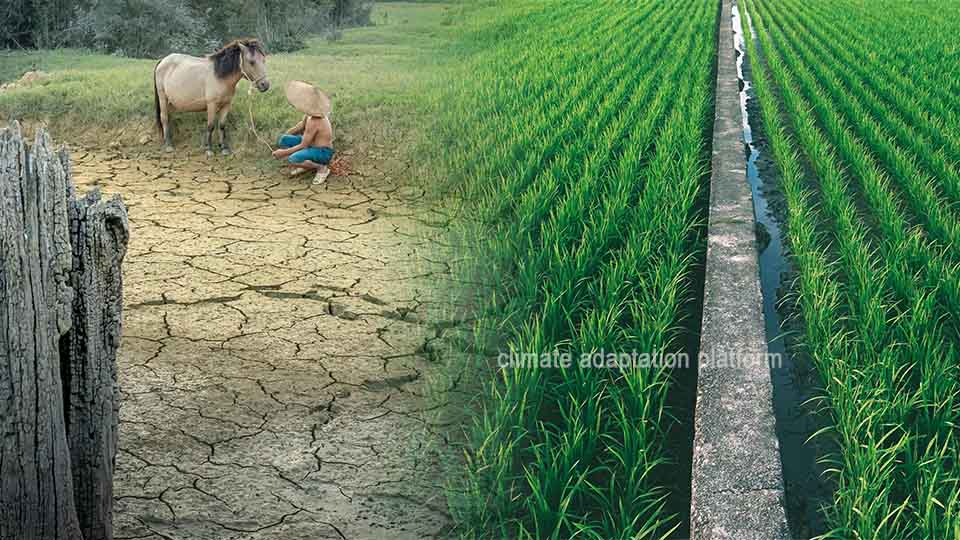
Agriculture is expected to face significant challenges in the future due to rising global food demand. This will place additional strain on freshwater supplies already under pressure from climate change.
The impacts of climate change on water resources and agriculture, sectors that must meet competing demands, particularly food production, will require smarter water management solutions. Agricultural water management (AWM) can help promote sustainable water use, reduce waste, and strengthen climate resilience and adaptation.
Various adaptation options are available for agricultural systems to address climate risks and improve resilience. These include developing irrigation systems, using climate-resilient crops, diversifying crops and livelihoods, applying water-saving measures such as Alternate Wetting and Drying (AWD), using micro-irrigation and deficit irrigation, and creating farm ponds.
However, the success of these adaptation measures depends on how well they suit a specific farming area or region, whether they align with farmers’ goals, and whether the outcomes help overcome local challenges. If these adaptation measures fail to meet these criteria, they may result in maladaptation.
Maladaptation is defined as “any changes in natural or human systems that inadvertently increase vulnerability to climatic stimuli, an adaptation that fails to reduce vulnerability and instead increases it”.
Study examines climate resilience in irrigated agriculture
The study, “Robust adaptation strategy for enhancing climate resilience in irrigated agriculture”, published in npj Climate Action in March 2025, assesses how irrigated agricultural systems can become more climate-resilient through different adaptation strategies. The research focuses on the Lower Bhavani Irrigation Project in Tamil Nadu, India, and evaluates several farming adaptation and water-management strategies under uncertain future climate conditions.
The Lower Bhavani Irrigation Project covers 83,700 hectares of rice paddy and supplies irrigation water to farms in the Erode, Tirupur, and Karur districts of Tamil Nadu. To maximise irrigation coverage despite limited water resources, the Water Resources Department allocates water so that only half of the total area is irrigated in a single season.
The study proposes two categories of adaptation strategies: water-management practices and agronomic practices. Water-management strategies include Alternate Wetting and Drying (AWD), Aerobic Rice Cultivation (ARC), and Deficit Irrigation (DI). Agronomic practices include shifting rice transplanting dates one or two weeks earlier or later than usual.
Compared with the traditional practice of continuously flooding rice paddies, these climate adaptation measures reduce total water use and improve water-use efficiency. Traditional farming methods use an average of 7,200 m³ of water per hectare, whereas these adaptation measures reduce water use by 526 to 2,986 m³ per hectare, approximately 7.3% to 41.5%.
Deficit irrigation emerges as the most robust strategy
The study also assessed the robustness of each adaptation strategy, i.e., whether the system could continue to function effectively under a range of future climate conditions. Each strategy was stress-tested against 168 future climate scenarios by adjusting precipitation and temperature levels. This approach was used to identify the adaptation tipping point (ATP), the most stressful climate condition under which the strategy still performs effectively.
The researchers found that Deficit Irrigation (DI) was the most robust strategy, meeting performance thresholds across all 168 future climate scenarios, meaning sufficient water remained available to meet crop demands. Alternate Wetting and Drying (AWD) was nearly as robust, failing in only 1 of 168 scenarios. In contrast, agronomic strategies, particularly advancing transplanting by one week, were the least robust, failing under all future climate conditions tested.
When crop yields were assessed, the findings were more mixed. Yields fell below the threshold compared with the base scenario or current rice-farming practices for most adaptation measures, except for AWD and Deficit Irrigation, where yields remained at or above acceptable levels.
The study also found that transplanting one week earlier or later increased the risk level from low to high, making these practices potential examples of maladaptation, as they may reduce yields and negatively affect farmers’ livelihoods. Severe AWD, where field water levels fall to 20 cm below ground level and soil water potential drops below −20 kPa, indicating significant dryness, can reduce crop yields by up to 20%.
“Our findings show that adaptive water management strategies are generally more robust and risk-tolerant than agronomic interventions, while also highlighting potential maladaptation risks that could impact crop yields,” wrote Mukand Babel, one of the study’s authors, on LinkedIn.
He added, “Overall, the study underscores the importance of flexible, adaptive water management in strengthening climate resilience in agriculture.”
Learn more about the study by visiting the link provided below.
Source:
Kamalamma, A. G., & Babel, M. S. (2026). Robust adaptation strategy for enhancing climate resilience in irrigated agriculture. Npj Climate Action, 5(1), 34. https://doi.org/10.1038/s44168-026-00352-8
Leave a Reply