

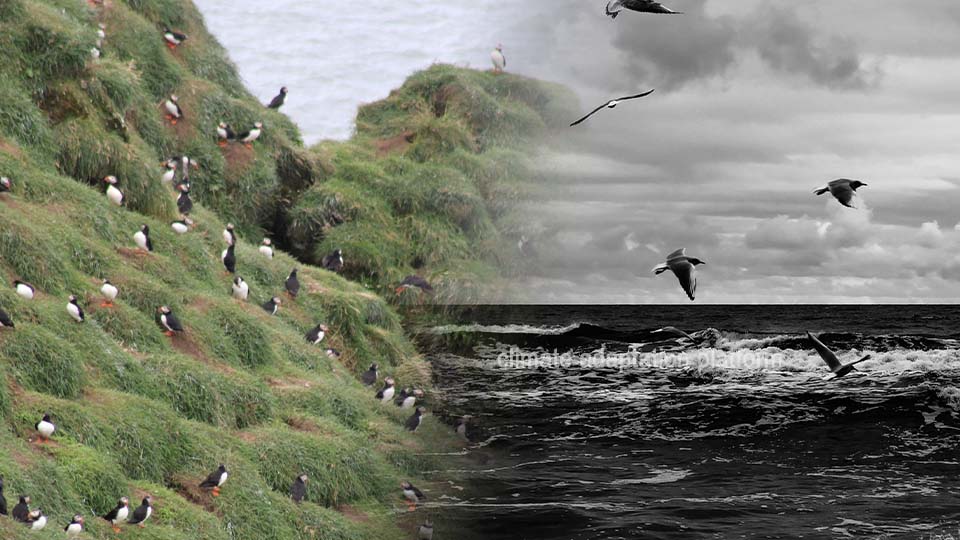
Seabird populations worldwide have declined by about 70% between 1950 and 2010. The decline is mainly caused by human activities such as overfishing, which reduces their food supply; pollution; climate change; and mortality from fishing activities. Seabird decline is also occurring in the Southern Ocean, where many threatened species live and feed.
To track their populations, scientists would use digital images from satellites or drones, or acoustic loggers for some burrowing species. While these innovations are effective in monitoring seabird populations, they don’t provide data on the longer-term impacts of human activities or natural events.
Such information is essential when developing plans to address or mitigate the decline in seabird populations or to assess the factors causing the problem.
Fortunately, lake sediments and peat cores act as natural archives, providing a window into the past that allows scientists to reconstruct historical or ancient conditions and, in turn, the long-term changes in seabird populations.
Many seabirds in the Southern Ocean nest on islands with lakes and wetlands. Seabirds eat animals like krill, squid, and fish. When they return to their nesting sites, they deposit guano (bird droppings) that is rich in nutrients.
This guano helps plants grow, forms peat, and can also wash into nearby lakes. The nutrients and elements from the guano end up in the sediments, providing a record that scientists can study to learn about seabird populations over long periods.
Bird Island is one of the most important seabird breeding sites on Earth, home to vast colonies of wandering albatrosses, petrels and penguins. A small island just off the northwest tip of South Georgia in the South Atlantic Ocean, it is also home to the Bird Island Research Station, which focuses on the long-term study of seabirds and seals in one of the world’s richest wildlife sites.
Scientists examining the island’s peatlands have made an interesting discovery, one that offers insight into how climate change will affect seabird populations. Ancient bird poo preserved on peatlands gave them a peek into 8,000 years of seabird history.
The study led by the Swedish University of Agricultural Sciences and the University of Bern in collaboration with the British Antarctic Survey is published in the published in The Proceedings of the National Academy of Sciences (PNAS), on 14 April 2026, titled, “Southern Ocean seabird population shifts over the Holocene revealed by peat sequestration of mercury from guano” showed how layers of ancient bird poo preserved in the peatlands revealed how bird numbers rose and fell with climate change which can predict their future population.
When birds nest on the slopes, their poo (guano) washes into the peatland below. The mercury from the fish they eat accumulates in their bodies. It passes into their guano, which, in turn, is trapped in successive layers of peat, creating a chemical record of the populations nesting above.
These chemical records of mercury from different depths of peat cores collected by scientists have allowed them to determine the bird population nesting above over thousands of years.
Linking bird population to wind strength
Analysing the mercury found in the seabird guano preserved in the peat, scientists determined that the first seabird colonies established on Bird Island were between 6,800 and 6,100 years ago, more than a millennium earlier than on other sub-Antarctic islands. They also found four periods when seabird numbers were high. These times matched periods when westerly winds in the Southern Hemisphere were weaker.
This discovery has important implications for predicting seabird population growth. Weaker winds have driven seabird populations to thrive. As climate change intensifies, the winds observed in recent decades will drive a decline in seabird populations.
Stronger winds mean higher energy use for seabirds. It can reduce the length of feeding trips, the amount of food they provide their chicks, and, ultimately, breeding success.
Stronger winds also increase the risk of crash landings, flooded nests, and thermal exposure. For species that nest on open ground, powerful gusts can blow chicks, and even adults, off their nests.
Seabird population decline also has a cascading effect on ecosystems – their guano recycles vital nutrients, and some estimates suggest these nutrients fuel up to 75% of ecosystem productivity across the wider global ocean.
Their decline will affect fisheries, ocean carbon cycling, and the health of ecosystems that people depend on.
Overall, the study shows that seabird populations have changed many times across thousands of years in response to natural climate shifts.
This suggests that the current strengthening of westerly winds could cause further declines in seabird populations in the Southern Ocean.
Source
Li, C., Roberts, S. J., Grosjean, M., Mestrot, A., Wille, M., Phillips, R. A., Enrico, M., Bishop, K., Skyllberg, U., Mauquoy, D., Von Scheffer, C., Theurer, T., Muirhead, D., Whittle, A., Gallego-Sala, A., Sonke, J. E., De Vleeschouwer, F., Braconnot, P., Marti, O., . . . Hodgson, D. A. (2026). Southern Ocean seabird population shifts over the Holocene revealed by peat sequestration of mercury from guano. Proceedings of the National Academy of Sciences, 123(16), e2533681123. https://doi.org/10.1073/pnas.2533681123
Ancient poo reveals uncertain future for Antarctic seabirds. (2026, April 17). British Antarctic Survey. Retrieved from https://www.bas.ac.uk/news/ancient-poo-reveals-uncertain-future-for-antarctic-seabirds/
Leave a Reply