

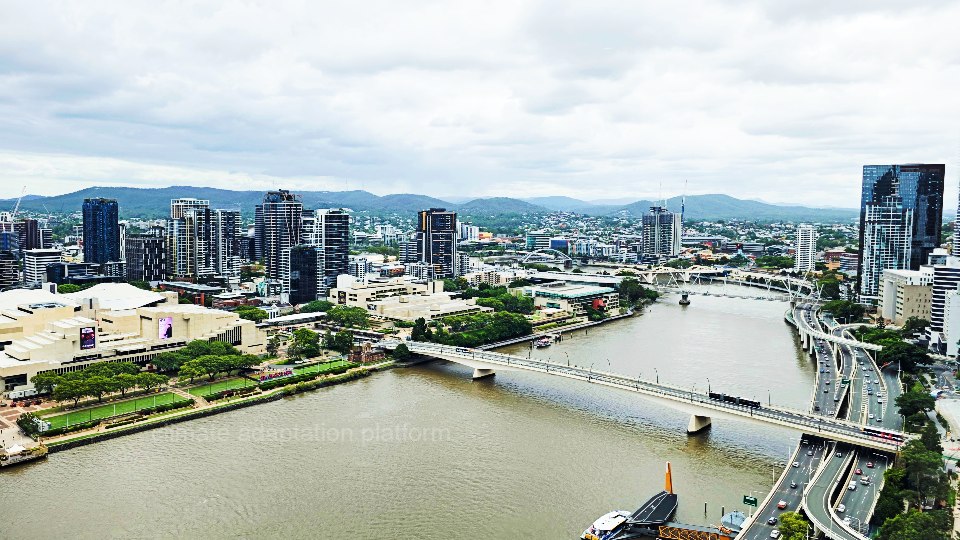
The UNDRR puts the cost of disasters in cities at more than $300 billion every year. Hazards and disasters also expose everything at risk, from the health and lives of urban residents to infrastructure, homes, and livelihoods.
The UN’s office for Disaster Risk Reduction identifies the factors that increase disasters, such as rapid population growth – more people are exposed to natural hazards, vulnerability of infrastructure, and low capacity of cities in terms of preparedness, including inadequate early warning systems and emergency response.
For cities to continue to grow and protect their development, urban planning must integrate risk considerations into land use, urban governance, and infrastructure investments while improving their liveability.
The Handbook for Livable and Resilient Cities: Integrating Hazard and Risk Information into Urban Planning is a guide for decision-makers, planners, and practitioners committed to building cities that are not only resilient but also liveable and economically vibrant.
The 200+ page handbook highlights how cities are vital hubs and nuclei for opportunities, living areas, innovation, and economic growth, and this trend will continue in the future, with over half of the world’s population, 67%, projected to live in cities by 2050, translating to around 7 billion people.
While cities are key centres of development and progress, they are also drivers of significant environmental, social, and economic challenges and are simultaneously exposed to and vulnerable to multiple hazards from natural disasters and climatic shocks, exacerbated by inadequate infrastructure, heightened exposure, and growing inequalities.
The handbook recommends a fundamental paradigm shift in how cities tackle these multiple risks and hazards informed by lessons learned. It notes that these risks, hazards, and their impacts will only escalate as climate change intensifies. expansion of urbanisation, which will amplify inequalities and disproportionately affect the most vulnerable populations.
The handbook presents the risk-informed urban planning approach, which is a shift from viewing “cities as passive arenas of disaster and climate exposure. Instead, it recognises urbanisation itself as a key driver that can either increase or decrease risk. From this perspective, planning decisions become proactive expressions of evidence-based risk reduction. Thus, integrating risk into planning is both a technical necessity and a governance imperative.”
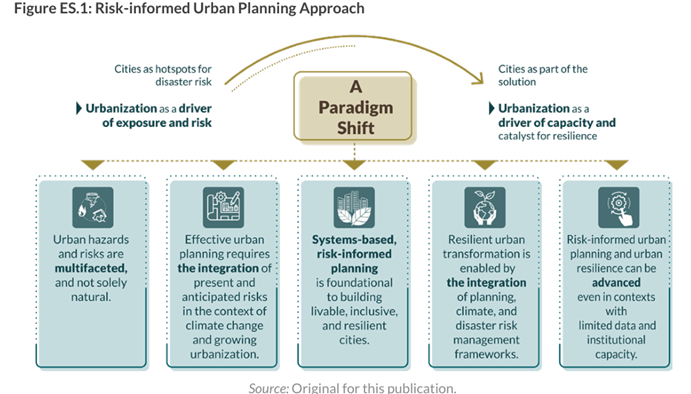
The handbook defines liveable and resilient cities as urban areas and their surroundings that promote green urban growth, social inclusion, resilient built environments, and shared prosperity. The focus is on preventing and reducing the impacts of natural hazards and risks, as well as the effects of climate change.
In a liveable and resilient city, planned and sustainable growth ensures that people have access to healthy environments, affordable housing, basic services, jobs, low-carbon transportation, and economic opportunities.
The handbook is divided into three sections.
Part 1 Conceptual Framework. Introduces the main concepts, principles, goals, governance, structures, planning scales, and capacities needed for undertaking risk-informed urban planning processes. It also describes restrict, condition, and promote (RCP) measures for risk-informed urban planning.
Part 2 Process and Instruments for Planning and Implementation. Elaborates on the operational process for embedding hazard and risk information into urban plans. Addresses regulatory, financial, and nonfinancial instruments and capacities for implementation, and explains the importance of monitoring and evaluation in updating and enhancing risk-informed urban plans.
Part 3 Integration of Different Types of Hazards and Risks into Urban Plans. These hazards cover hydrometeorological hazards (floods: flash, pluvial, riverine, and coastal), geohazards (earthquakes, shallow movements, and volcanic activities), and climatological hazards (extreme heat, heat waves, urban heat island, droughts, and wildfires).
Instead of examining large-scale drivers such as cyclones or climatic trends, it focuses on the primary and secondary hazards they generate, which directly affect the built environment and shape urban risk.
Each chapter in this section identifies risk-informed planning measures for RCP based on hazard and communities’ risk acceptability, and promotes resilience-enhancing action. These measures are consolidated in practical catalogues with examples to guide local planning and decision-making.
This section concludes with key takeaways explaining why cities should move beyond reactive measures and adopt proactive, integrated, and sustainable planning approaches to achieve liveability and resilience goals.
“The call to action is clear: cities must integrate climate and risk considerations into all aspects of planning and decision-making. This means shifting from a mindset of short-term gains to one of long-term resilience, where urban growth is managed with foresight, inclusivity, and environmental consciousness. Policymakers must adopt and enforce regulatory frameworks that embed risk prevention and reduction into urban planning.
Planners and practitioners must leverage data, innovation, and participatory processes to ensure that development aligns with resilience objectives.
Communities must be actively engaged, empowered to contribute their knowledge and priorities, and included in decision-making processes that affect their future.”
Sources
World Bank. 2025. The Handbook for Livable and Resilient Cities. Integrating Hazard and Risk Information into Urban Planning. Washington, DC: World Bank. Retrieved from https://openknowledge.worldbank.org/entities/publication/d7ee1212-42ed-4d8a-9ffa-225152ee65df
Orozco, C. (n.d.). Hazards and Drivers of Urban Risk. UNDRR. Retrieved from https://www.undrr.org/words-action-implementation-guide-land-use-and-urban-planning/hazards-and-drivers-urban-risk#:
Leave a Reply