


The UNDP and the University of Oxford’s global survey on climate change, which gathered views from over 70,000 respondents across 77 countries, representing 87% of the world’s population, reveals that the majority of respondents – 81%- want their government to take more action on climate change.
Respondents to the landmark report, the People’s Climate Vote 2024, now in its second edition, also believe that the government is most impactful in addressing climate change.
In 89% of countries surveyed, more respondents said their government has had the biggest impact on addressing climate change than any other group, averaging 43% of people globally.
Worldwide, respondents also acknowledged the impactful role of other groups in addressing climate change, such as big businesses (14%), the United Nations (13%), and campaigners and activists (12%).
While respondents to UNDP’s global survey believe that governments and businesses are the key drivers in stopping climate change, a WRI research result identifies 19 individual behaviours that can stabilise the climate, ranking them by efficiency. If done collectively by a large number of people, it could halt climate change, the research notes.
While some narratives about individual behaviours that could impact climate change can be confusing, as a 2025 study involving nearly 4,000 Americans found. It finds that many people hold false beliefs about the effectiveness of certain actions, such as recycling, compared to avoiding long flights, which is more impactful. This misunderstanding, the study notes, can lead to poor choices when addressing climate change.
The study finds that the following actions — taking fewer flights, not adopting a dog, or eating lower-carbon meats — achieve the highest levels of carbon emissions reductions and behavioural changes after respondents have been exposed to literacy interventions.
Below are the 19 individual behaviours from the WRI study, ranked by their efficiency in fighting climate change.
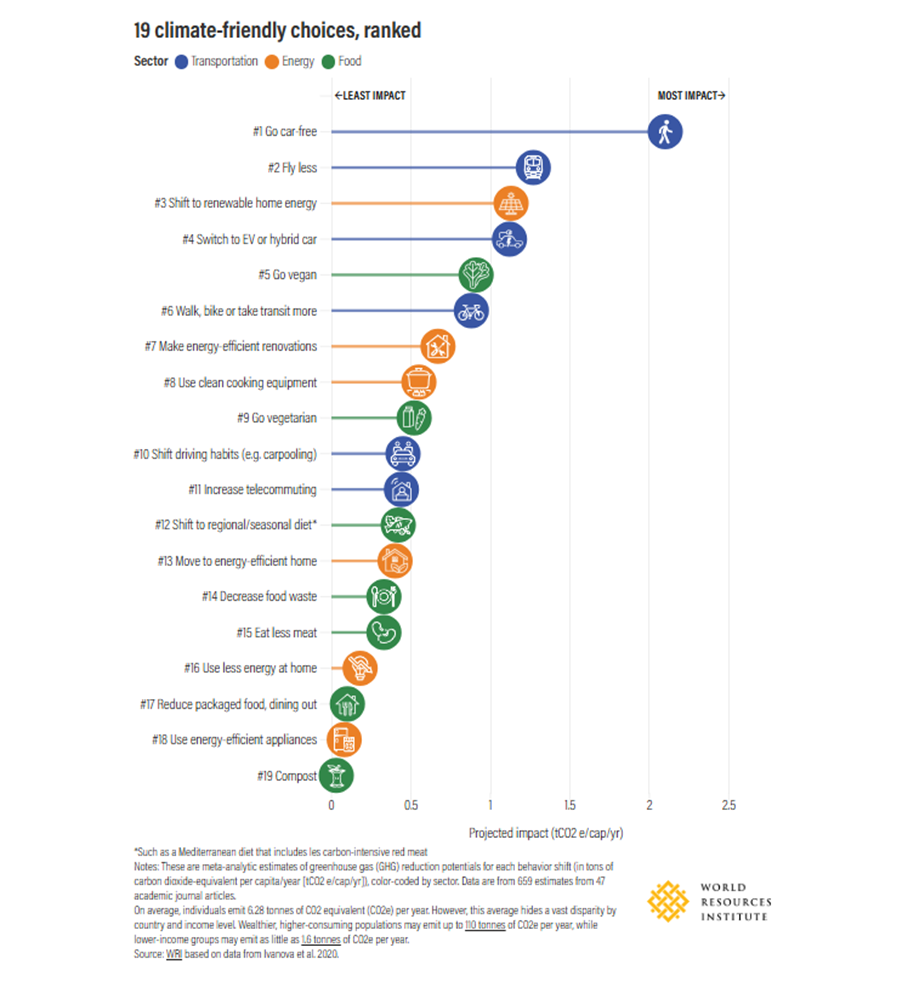
The WRI paper merges two previously disconnected research domains: studies estimating the theoretical emissions reductions possible through behaviour change and studies evaluating the effectiveness of individual-level behaviour change interventions.
Combining these two literatures, the paper measures the actual emissions reductions that can realistically be achieved through individual-level behaviour changes.
The study notes that adopting just a few of the actions identified above, particularly those most impactful for stabilising the climate, such as going car-free, taking fewer flights, shifting to renewable energy at home, and switching to EVs or hybrid cars, can make a difference. However, the catch is that it should take billions of people on the planet.
The working paper identified “Priority Shifts” with a particularly high projected impact on emissions, noting that these are especially relevant for higher-income, higher-consuming populations, which have a greater responsibility to reduce their emissions. In order of climate change impact, these behaviours are:
- Shifting to sustainable ground travel (such as by decreasing gas-powered car use, using public transport and cycling).
- Shifting to air travel alternatives (like high-speed rail and teleconference).
- Installing residential solar and increasing home energy efficiency.
- Eating more plant-rich meals.
The findings from this body of literature – from the UNPD survey, study, and WRI working papers emphasise the significant impact on mitigating climate change that individual behaviours can have when adopted at scale.
A collective commitment to prioritising sustainable practices such as reducing air travel, embracing plant-rich diets, and enhancing home energy efficiency can drive substantial emissions reductions.
However, to make these individual behavioural shifts truly impactful, they should be enabled by government policies and industry practices. When these factors align, personal and institutional changes can reinforce each other.
Sources:
Peoples’ Climate Vote 2024. (2024, June). UNDP. Retrieved from https://peoplesclimate.vote/document/Peoples_Climate_Vote_Report_2024.pdf
Hernandez, M. & Composto, J. (2025, October 9). 19 Ways to Help the Climate, Ranked. WRI. Retrieved from https://www.wri.org/insights/climate-friendly-choices-ranked?
The Effective Impact of Behavioral Shifts in Energy, Transport, and Food. (2025, April 9). WRI. Retrieved from https://www.wri.org/research/effective-impact-behavioral-shifts
Goldwert, D., Patel, Y., Nielsen, K. S., Goldberg, M. H., & Vlasceanu, M. (2025). Climate action literacy interventions increase commitments to more effective mitigation behaviors. PNAS Nexus, 4(6). https://doi.org/10.1093/pnasnexus/pgaf191
Leave a Reply