

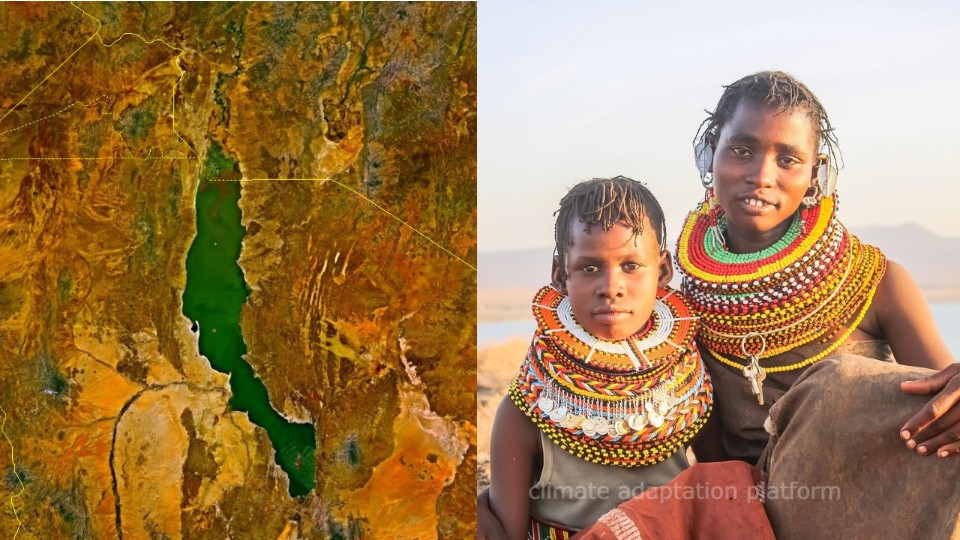
Climate change effects can alter the lake’s water level. A significant decrease in the lake’s water levels could result in the lightening of the Earth’s crust, leading to more earthquakes, according to research led by Dr James Muirhead of the University of Auckland, with collaborators at Syracuse University in the US.
The location and subject of the study is North Kenya’s Lake Turkana, the world’s biggest permanent desert lake, and where the African continent is slowly splitting apart – as the eastern and western sides move away from each other, making it an ideal setting to explore how changes to the Earth’s surface and climate affect deep-earth processes.
According to the study, over the last 6000 years, water levels in Lake Turkana have dropped by 100 to 150 meters, reducing surface pressure on Earth’s crust and allowing plates to move more easily.
Talking to RNZ, Muirhead says the drop in Lake Turkana’s water levels occurred over the last 5000 years, at the end of the African humid period, when it was wetter and received more rainfall. A drier period ensued, and since then, the drop in lake levels has corresponded with increased movement on many fault lines in the study area, thereby increasing the probability of an earthquake.
He explains that any change in the Earth’s surface load, and not just water, but activities like the damming of rivers, or releasing dam water, and the retreat of glacial ice, with the latter causing earthquakes in parts of Europe and North America. The reason is that when the weight is removed from Earth’s surface on a fast enough timescale, the crust will begin to relax as the pressure decreases.
And in areas where this pressure or load is near a fault line, as in the study location, it could increase the likelihood of earthquakes, magmatism, and volcanic eruptions. But according to Muirhead, these changes occur on geological timescales, not over human lifetimes, meaning the possibility of earthquakes also spreads over these prolonged periods.
“We tend to think of earthquakes and volcanoes as being driven purely by deep forces inside the Earth,” says Muirhead, who’s in the University of Auckland’s School of Environment. “But what we’re seeing here is that surface processes – like climate and rainfall – also play a role. The study is the first empirical evidence of the effect in the East African Rift System, the scientists say (How climate can, 2025).
Implications of research.
Findings from this research contribute to a body of evidence that climate change influences earthquakes. Researchers show that changes in lake water levels due to climate change can influence the likelihood of earthquake events.
When asked about the implications of his research, Muirhead explains that awareness of human activities changing the way Earth’s surface operates and will have a much larger effect on Earth’s systems can have important implications for the future of asset and urban planning.
Sources:
Xue, L., Muirhead, J. D., Moucha, R., M. Wright, L. J., & Scholz, C. A. (2023). The Impact of Climate-Driven Lake Level Changes on Mantle Melting in Continental Rifts. Geophysical Research Letters, 50(18), e2023GL103905. https://doi.org/10.1029/2023GL103905
How climate can alter earthquake risk: new study. (2025, November 11). University of Auckland. Retrieved from https://www.auckland.ac.nz/en/news/2025/11/11/-how-climate-can-alter-earthquake-risk–new-study-.html
Increased risk of earthquakes with climate change. (2025, November 22). RNZ. Retrieved from https://www.rnz.co.nz/national/programmes/saturday/audio/2019013817/increased-risk-of-earthquakes-with-climate-change
FEATURED IMAGE CREDIT: Satellite image of Lake Turkana by Photograph: NASA – NASA World Wind, Public Domain, https://commons.wikimedia.org/w/index.php?curid=654760. The image has been cropped to fit website requirement.
Leave a Reply