

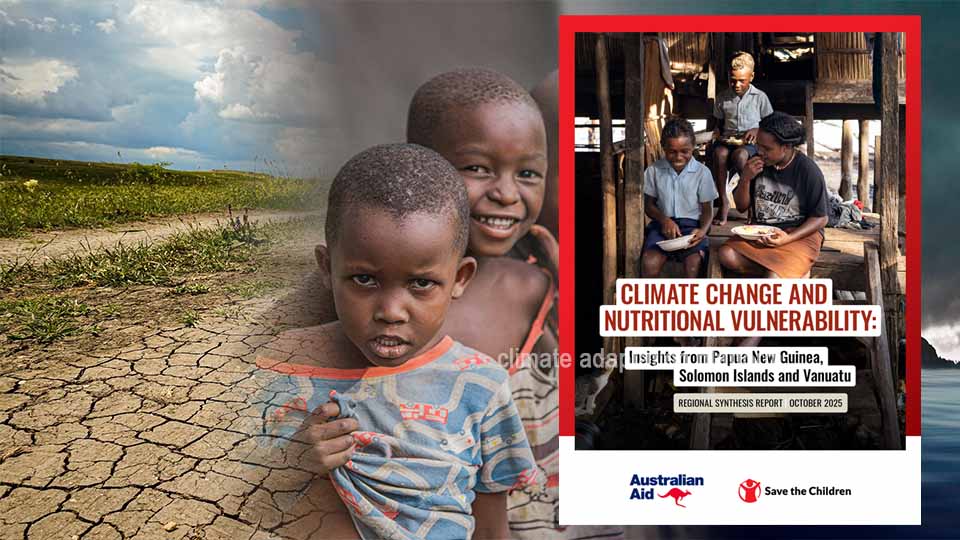
A study by Save the Children, published in October 2025, highlights the twin crises confronting Melanesian communities: malnutrition and climate change.
Focusing on the first 1,000 days of children’s lives in Papua New Guinea, the Solomon Islands, and Vanuatu, the study finds that children across the region are experiencing a “triple burden of malnutrition”: stunted growth, anaemia, and overweight.
Melanesia is a subregion of Oceania in the south-western Pacific Ocean, home to five countries: Indonesia, Papua New Guinea, Fiji, the Solomon Islands, and Vanuatu, as well as the territory of New Caledonia.
Despite its cultural richness and strong community traditions, the region is increasingly vulnerable to climate-related shocks that are undermining nutrition and health outcomes, particularly for young children.
The first 1,000 days and why they matter
According to UNICEF, the first 1,000 days span the period from conception to a child’s second birthday. This window is critical for physical growth and cognitive development, with long-term consequences for health, learning, and productivity later in life. Adequate nutrition, maternal health, safe water, sanitation, and appropriate feeding practices during this period are essential for children to reach their full potential.
When these foundations are disrupted by poverty, food insecurity, or environmental stress, the impacts can be lifelong and difficult to reverse.
Climate change as a driver of nutritional vulnerability
The study finds that climate change, both rapid-onset and slow-onset, is intensifying existing vulnerabilities in Papua New Guinea, the Solomon Islands, and Vanuatu. More frequent and severe cyclones and floods, prolonged droughts, rising temperatures, shifting rainfall patterns, and sea-level rise are no longer isolated events. Instead, they form a cycle of preparation, survival, and recovery with little time for communities to rebuild.
These cumulative pressures are undermining food systems and public health services, deepening nutritional insecurity. Climate shocks disrupt food production and livelihoods, drive up food prices, and limit access to markets during extreme weather events. Damage to health facilities and transport infrastructure further restricts access to healthcare, safe drinking water, sanitation, and hygiene, critical components of good nutrition, particularly for mothers and young children.
The scale of malnutrition in Melanesia
The study reveals alarming levels of malnutrition across the three countries examined. One in three Melanesian children experiences stunting, anaemia, or overweight. In Papua New Guinea, nearly 48.2% of children are stunted due to chronic malnutrition.
In the Solomon Islands, approximately 32% of children are stunted, while in Vanuatu, 29% of children experience stunting, and 8% of children under five are affected by wasting.
The table below from the study shows the prevailing malnutrition in Papua New Guinea, the Solomon Islands, and Vanuatu.
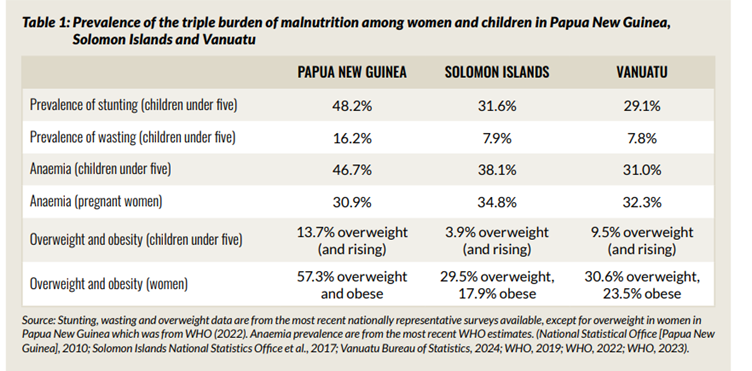
These figures reflect not only food shortages but also diets increasingly dominated by low-nutrient, processed foods, limited access to health services, and repeated climate-related disruptions.
Socioeconomic and cultural pressures
The study identifies several factors that exacerbate malnutrition. Income insecurity and limited land ownership restrict households’ ability to grow food or earn a reliable livelihood. Extreme weather events often lead to crop failures and sudden spikes in food prices, forcing low-income families to reduce food intake or rely on less nutritious options.
Substance abuse, including alcohol, marijuana, and kava, is another contributing factor, closely linked to economic stress and social disruption. It can divert household income away from food purchases and interfere with childcare practices, feeding routines, and food preparation.
The research also highlights the erosion of “wantok”, a traditional system of food sharing and mutual support within Melanesian communities. While once essential for surviving lean seasons, declining agricultural yields, worsening shortages, and a shift towards individualised consumption have weakened these informal safety nets.
Save the Children’s Vanuatu Director, Polly Banks, urges governments and development partners across the Pacific to prioritise nutrition within climate adaptation strategies:
“We are calling for increased attention to embedding nutrition in climate adaptation efforts and adopting climate-sensitive approaches across food, health, and water systems. We have an opportunity to act now, before the impacts of climate change on nutrition become irreversible.”
Source:
Save the Children Australia and Dikoda (2025) “Climate change and nutritional vulnerability: insights from Papua New Guinea, Solomon Islands and Vanuatu. Regional Synthesis Report”. Save the Children Australia, Melbourne. https://www.savethechildren.org.nz/assets/Files/Reports/Pacific-Climate-Nutrition-Study-October-2025.pdf
PACIFIC: Collision of crises deepens child nutrition challenges in PNG, Solomon Islands and Vanuatu. (2025, October 16). Save the Children. Retrieved from https://www.savethechildren.org.nz/media-hub/collision-of-crises-deepens-child-nutrition-challenges#:~:text=A%20new%20study%20from%20Save,and%20intense%20in%20the%20Pacific.
Leave a Reply