

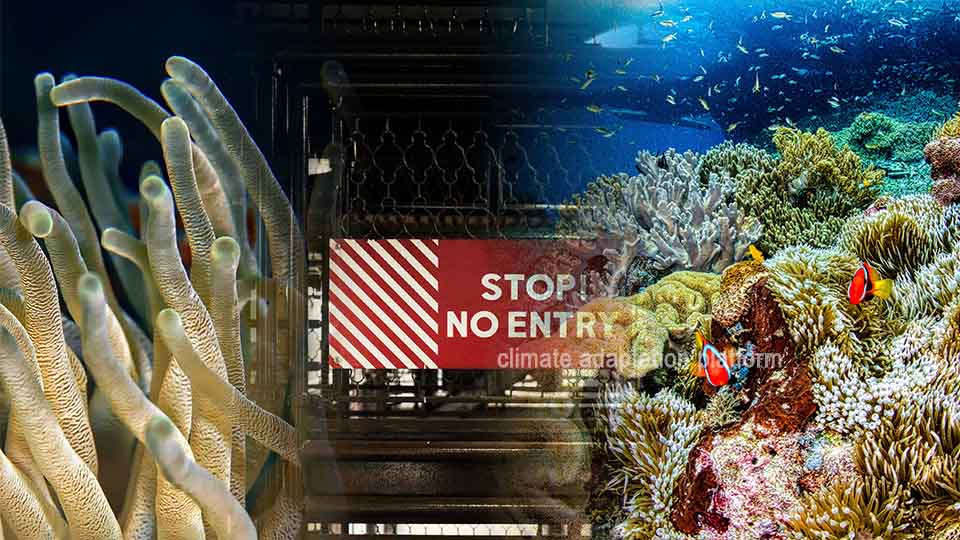
Traditional coral reef conservation is no longer sufficient to protect reef habitats amid accelerating climate change.
As marine heatwaves increase in frequency, intensity, and duration, and ocean chemistry shifts due to acidification, the long-held assumption that protecting reefs from local threats alone can ensure their survival has proven increasingly inadequate.
An article published in AGroSpectrum India argues that coral reefs must now be managed as climate-resilience infrastructure rather than passive conservation areas.
For decades, Marine Protected Areas (MPAs) have been designated to limit fishing, reduce land-based run-off, and improve coastal management, allowing coral systems to recover and withstand environmental shocks.
While these measures remain important, the article contends they are no longer enough. Instead, it calls for a reframing of reef governance, one that treats reefs as dynamic systems requiring active management and sustained investment.
“The future of coral reefs will depend on dynamic, data-driven management, active restoration, and financial mechanisms that treat reef health as essential climate-resilience infrastructure.”
Climate change impacts on coral reefs
Camille Gaynus, Chief Science Officer at Black in Marine Science (BIMS), explains that climate change is pushing environmental conditions, such as temperature and water chemistry, beyond the limits many corals can tolerate.
Rising sea temperatures and pollution drive coral bleaching, weakening reefs and increasing mortality. While some coral–algae partnerships exhibit heat tolerance, Gaynus notes that even when reefs recover, the resulting ecosystems are often fundamentally different.
Jenni Brandon, PhD, a Science and Sustainability Consultant at Wild Beacon Consulting, highlights that approximately 14% of the world’s coral reefs were lost between 2009 and 2018.
Climate change impacts reefs through multiple pathways, including sea-level rise, sedimentation, stronger and more frequent storms, altered rainfall patterns, and increased run-off carrying freshwater and pollutants.
However, Brandon stresses that ocean warming and acidification remain the primary drivers of mass coral bleaching events.
Although more than 80% of the world’s reefs are currently experiencing bleaching, some demonstrate remarkable resilience. For example, corals in the Red Sea show adaptation to warmer waters, while reefs in cooler regions sometimes recover through larval dispersal from distant reef systems.
These observations suggest that coral reefs are not inevitably doomed, but their survival will require targeted, climate-aware intervention.
Climate-smart marine protected areas
The article advocates adopting climate-smart MPAs, a new conservation paradigm proposed by marine scientists and practitioners. Unlike traditional MPAs, climate-smart MPAs embrace adaptive, intervention-based management approaches.
These MPAs prioritise dynamic zoning and adaptive governance, recognising that reef systems are not static in a warming ocean. Boundaries and regulations evolve based on real-time environmental data, allowing for measures such as relocating species to cooler or deeper waters during extreme heat events.
Active resilience-building is also central to this model. Climate-smart MPAs integrate large-scale restoration efforts, assisted evolution (including breeding heat-tolerant coral strains), microbiome manipulation, artificial reef structures, and shading technologies. Rather than being “no-touch” zones, these MPAs become hubs of strategic intervention.
Monitoring and technology underpin this approach. Investment in satellite imagery, drones, autonomous underwater vehicles, AI-driven reef analysis, and heat-anomaly forecasting enables managers to anticipate risks and respond proactively rather than react after damage occurs.
Financing reefs as climate infrastructure
Crucially, next-generation MPAs are linked to innovative financial and governance models aligned with climate-resilience outcomes. This shift moves beyond donor-dependent conservation towards mechanisms such as resilience bonds, insurance-linked protection, and private-sector investment tied to ecosystem services.
The article highlights initiatives such as the Global Fund for Coral Reefs, supported by the World Bank and the Global Environment Facility, which explores financing models that integrate reef health with coastal defence and tourism risk reduction.
Island nations heavily dependent on reef-based tourism, including the Seychelles, are beginning to pilot parametric insurance schemes linked to reef condition.
In conclusion, the article calls for a paradigm shift from a “protect and leave alone” model to a “protect, adapt, and finance” model. Treating coral reefs as infrastructure recognises their essential role in coastal protection, food security, and climate adaptation.
This perspective aligns with the concept of “Infrastructural nature”, explored in a 2021 Sage Choice article, which argues that viewing ecosystems as infrastructure supports long-term investment in their maintenance and function.
Examples such as California’s 2016 watershed management legislation demonstrate how natural systems can be funded and governed alongside traditional “grey” infrastructure.
However, framing nature as infrastructure, as in coral reef management, also raises important questions about territory, labour, and finance.
While it can unlock new funding streams, it risks financialising ecosystems, potentially reshaping power dynamics and control over natural resources.
As coral reefs become investable assets, balancing ecological integrity, social equity, and financial interests will be critical.
Source:
Reefs as climate infrastructure: Case for treating coral systems like coastal assets. (2025, October 27). AGroSpectrum. Retrieved from https://agrospectrumindia.com/2025/10/27/reefs-as-climate-infrastructure-case-for-treating-coral-systems-like-coastal-assets.html
Nelson, S. H., & Bigger, P. (2021). Infrastructural nature. Progress in Human Geography, 46(1), 86. https://doi.org/10.1177/0309132521993916
Leave a Reply