


A new study published in Advances in Atmospheric Sciences on 6 January 2026 shows that ocean temperatures in 2025 reached another record, as the ocean absorbed more heat last year than in any year since measurements began in the 1960s.
The study provides an updated assessment of global sea surface temperatures (SST) and upper-ocean heat content (OHC) for 2025. According to the Institute of Atmospheric Physics at the Chinese Academy of Sciences (IAP/CAS), in 2025, the heat accumulated in the oceans increased by around 23 ZJ (zettajoules), a large increase from the 16 ZJ absorbed in 2024.
This finding is confirmed by three additional independent research groups: the CIGAR-RT, the National Centers for Environmental Information at the National Oceanic and Atmospheric Administration (NCEI/NOAA), and Copernicus Marine.
A single zettajoule is equivalent to 1,000,000,000,000,000,000,000 joules. Twenty-three zettajoules in one year is equivalent to the energy of 12 Hiroshima bombs exploding in the ocean every second.
The study focused on the upper 2,000 meters of the ocean to measure the ocean’s heat content, where most heat accumulation occurs, and measurement coverage is most reliable.
The global OHC estimates are based on three gridded observational products from IAP/CAS, Copernicus Marine, NCEI/NOAA, and an ocean reanalysis dataset, CIGAR, a product from CNR ISMAR (Italian National Research Council’s Institute of Marine Sciences) that combines actual ocean measurements with computer model simulations to fill in gaps.
The ocean absorbs approximately 90% of the excess heat trapped by greenhouse gas emissions in Earth’s climate system. The atmosphere, despite being what we most directly experience, only retains about 1% of this excess heat. The remaining heat goes into melting ice and warming land.
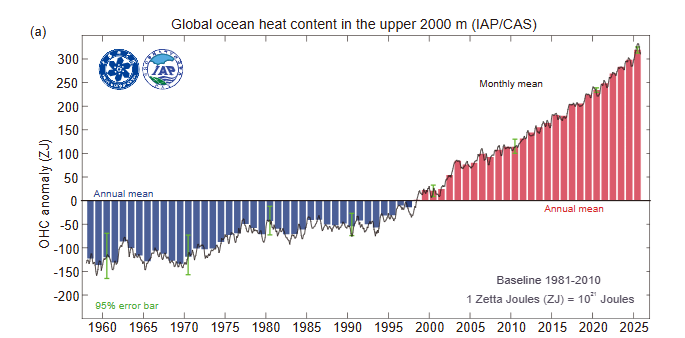
Ocean heat content (OHC) changes are less affected by short-term weather and El Niño events than global mean surface temperature (GMST), making them a reliable sign of long-term climate change. Observations show that OHC has steadily increased over time, highlighting a continuous buildup of extra heat in the Earth’s system.
Higher OHC leads to more frequent and intense marine heatwaves, changes in atmospheric circulation, greater evaporation and moisture in the air, and stronger extreme rainfall, all of which help tropical cyclones intensify rapidly. The ongoing, unusually warm ocean conditions in 2025 have played a significant role in driving extreme weather and climate events worldwide.
The study notes that ocean warming is not uniform, with some areas warming faster than others. “Regionally, about 33% of the global ocean area ranked among its historical (1958–2025) top three warmest conditions, while about 57% fell within the top five, including the tropical and South Atlantic Ocean, Mediterranean Sea, North Indian Ocean, and Southern Oceans, underscoring the broad ocean warming across basins”.
Ocean warming has major effects on our planet. Rising ocean heat content (OHC) is the main driver of sea level rise, intensifies marine heatwaves, and contributes to more extreme weather by adding heat and moisture to the atmosphere.
Continuous GHG emissions will increase OHC. Monitoring of OHC will inform the pace of climate change.
This will entail strengthening space-based observation and ocean monitoring to support climate adaptation planning and to better respond to climate change.
Source
Pan, Y., Cheng, L., Abraham, J. et al. Ocean Heat Content Sets Another Record in 2025. Adv. Atmos. Sci. (2026). https://doi.org/10.1007/s00376-026-5876-0
Leave a Reply