

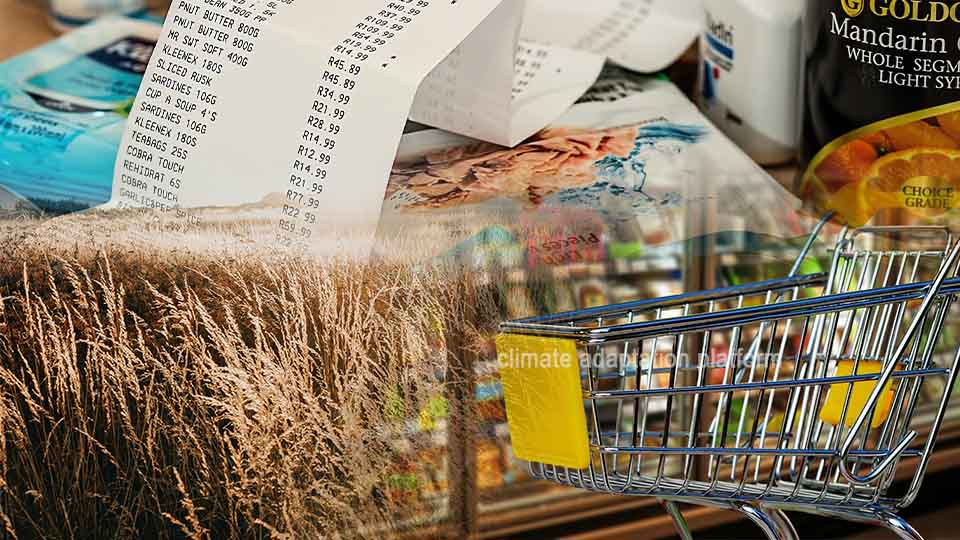
Food production accounts for a quarter of global emissions, making it a major contributor to climate change.
In turn, extreme weather events — such as severe droughts, heavy rainfall, extreme heat, and wildfires — driven by climate change are adversely affecting every stage of food production—from growing crops to transportation, processing, storage, and packaging—driving up food prices. These rising costs squeeze both farmers’ profit margins and household grocery budgets.
In poorer countries and regions with insufficient food, extreme weather events will further worsen food insecurity and malnutrition, potentially leading to political and social unrest.
The 2024 study “Global warming and heat extremes to enhance inflationary pressures”, published in the Nature journal, examines 27,000 monthly price records from around the world and shows that when temperatures rise, food prices go up, and overall prices keep rising for at least a year in both lower- and higher-income countries.
The study projects that by 2035, global food prices will increase by 1-3 percentage points per year, and overall prices by up to 1.2% per year. Those living at the equator will be most affected by the food price hike, while those farther from the equator will experience more seasonal effects, with the greatest impact in summer. For instance, Europe’s extreme heat in 2022 has raised food prices by 0.4-0.9%. The study notes that if the world reaches the warming projected for 2035, food prices could increase by 30-50%.
When Cyclone Gabrielle hit New Zealand in February, it damaged vast areas of crops, driving prices up. Kumara’s price, a beloved vegetable, has doubled, as have those of other vegetables like cauliflower and broccoli, affecting the diets of New Zealanders, especially those who want to eat healthy. Supermarkets warned customers that prices would remain higher until the next harvest.
The article in Climate Central, “Climate Change and Food Prices“, also provided a documented example of how climate extremes influence food prices – the intense drought in California and Arizona in 2022 drove vegetable prices up by 80% compared to the previous year.
In Brazil the 2023 to 2024 drought has increased the price of coffee to 55%, In Ghana, drought and heatwave in 2024 have shot prices of cocoa 280% higher than a year prior. Lastly, Hurricane Ian has reduced the orange harvest during the 2022 to 2023 harvest.
Carbon Brief also presented more examples of how extreme weather impacts food production and price, such as:
- How the record-breaking heat in Europe in summer 2022 has increased food inflation by up to 0.93%
- Heavy rainfall and soaked soils has delay crop planting in the United Kingdom from 2021 to 2024
- Orange production in the US fell 40% due to disease and the effects of Hurricanes Irma and Ian
- Olive oil production declined globally between 2021 and 2024 due to high temperatures, and as a result, olive oil prices have soared in many parts of the world, including New Zealand, and finally
- Extreme rainfall in China slashed rice yields by around 8% from 1999 to 2012
The examples from around the world reveal a concerning message: While food systems emit significant GHG emissions that contribute to climate change, climate change also disrupts food production and drives up prices. No region is immune to extreme weather events fuelled by climate change.
Addressing this issue requires actions on two fronts: (1) reducing the carbon intensity of food production and (2) adapting food systems to withstand the impacts of climate change, which are now becoming unavoidable.
Sources:
Taylor, T. (2023, March 2). Cyclone Gabrielle: Cost of some vegetables skyrocket, kūmara price doubles. NZ Herald. Retrieved from https://www.nzherald.co.nz/the-country/news/cyclone-gabrielle-cost-of-some-vegetables-skyrocket-kumara-price-doubles/G4CX3IBDNZD73ETB7DUVRWP2BY/
Climate Change and Food Prices. (2025, November 19). Climate Central. Retrieved from https://www.climatecentral.org/climate-matters/climate-change-and-food-prices
Kotz, M., Kuik, F., Lis, E., & Nickel, C. (2024). Global warming and heat extremes to enhance inflationary pressures. Communications Earth & Environment, 5(1), 116. https://doi.org/10.1038/s43247-023-01173-x
Dwyer, O. (2024, October 23). Five charts: How climate change is driving up food prices around the world. Carbon Brief. Retrieved from https://www.carbonbrief.org/five-charts-how-climate-change-is-driving-up-food-prices-around-the-world/
Butler, S. (2025, July 21). Rising food prices driven by climate crisis threaten world’s poorest, report finds. The Guardian. Retrieved from https://www.theguardian.com/business/2025/jul/21/rising-food-prices-driven-by-climate-crisis-threaten-worlds-poorest-report-finds
Leave a Reply