

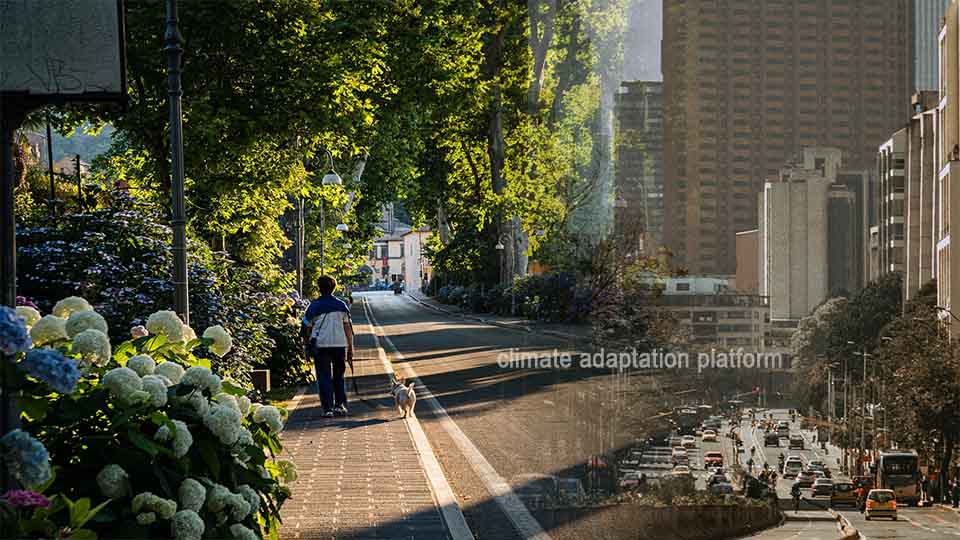
Bogotá, like many other cities, has an air pollution problem. Over 40% of cities worldwide face air pollution. Air pollution levels in Colombia’s capital city are more than 7 times the WHO’s recommended limit.
Bogotá’s high elevation and its location in the Andes do not help; instead, its mountainous terrain acts as a barrier, trapping air pollution like a cloak over the country’s capital.
Air pollution in the city comes from the outside, such as sand blown from the Sahara Desert and wildfire smoke, and from the inside, such as vehicle and factory emissions.
The WRI article discusses what the capital city is doing to address its air pollution problems.
The city launched the “Barrios Vitales” (vital neighbourhoods) in 2024. The program targets neighbourhoods directly impacted by air pollution, starting in San Felipe, a mixed-use area, where the city introduces a new pedestrian zone – replacing car traffic with pedestrians and cyclists – to encourage people to shift to more active forms of transportation and use public transit.
These changes led to positive outcomes – an 81% increase in public transport and an 82% increase in bike and scooter use. Walking also increased from 16% to 21%. Regarding air pollution, the San Felipe neighbourhood saw a 13% drop in PM2.5 levels thanks to the Barrios Vitales program.
The success of the Barrios Vitales program pilot in San Felipe has led the city to expand the program to many other neighbourhoods, particularly those with traffic congestion problems, aiming to reach 33 Barrios Vitales by 2035.
In addition to creating new pedestrian and green spaces and adding street furniture, the city partnered with WRI to improve its air quality monitoring system through the CanAIRy Alert air quality forecast model.
This new model combines NASA atmospheric modelling tools with local air quality monitoring data to provide an accurate city-specific forecast up to 5 days in advance. A forecast of high-pollution events allows people to avoid open spaces or reduce private vehicle use to help slash emissions.
The article also notes that Bogotá has deployed close to 1,500 electric buses, with 600 more to come, two cable cars—one in operation and one under construction—and 24 kilometres of metro line, while also extending and improving its 600 kilometres of bike lanes. The city also plans to expand functional greenery, such as street trees.
The UNEP presents five other cities worldwide tackling air pollution, including Bogotá, Colombia.
Bogotá, Colombia, is one of Latin America’s leaders in reducing air pollution. The city is electrifying its public bus network, aiming to fully electrify the metro system and encourage bike use.
Warsaw, Poland. Air pollution in the country accounts for more than 47 thousand deaths per year. In 2022, Breathe Warsaw, a partnership with Clean Air Fund and Bloomberg Philanthropies to improve air quality, launched 165 air sensors across the city. Breathe Warsaw will use them to develop an air quality database, enabling officials to better understand pollution sources.
Seoul, South Korea. The 26 million people living in Greater Seoul are exposed to PM2.5 levels that are twice those in other major cities in developed countries. In 2020, the city announced it would ban diesel cars from all public-sector and mass-transit fleets by 2025.
Accra, Ghana. The World Health Organization (WHO) data shows that over 28,000 people die prematurely every year due to air pollution, with PM2.5 levels in Accra five times above WHO guidelines. The city has started a campaign to educate people about the health dangers of indoor cookstoves and to discourage locals from burning their waste.
A joint effort between the WHO and the Climate and Clean Air Coalition is supporting a city-wide assessment of the health benefits of switching to more sustainable transport, waste, and household energy systems.
Bangkok, Thailand. Bangkok’s heavy traffic is causing severe air pollution, leading to the closure of hundreds of schools in 2020 when PM2.5 levels reached unsafe levels. The city has launched several initiatives to tackle both air pollution and carbon emissions.
One of them is the Green Bangkok 2030 project, launched in 2019, which aims to increase the city’s green space ratio to 10 sqm per person, to have trees covering 30% of the city’s total area, and to build a 15km greenway. The city also encourages a reduction in reliance on private transportation, thereby reducing pollution.
Trends on how cities worldwide address their air pollution problems.
Cities worldwide are taking proactive steps to combat urban air pollution. These strategies for addressing urban air pollution also align with principles of sustainable urban planning and share common elements such as:
- Low-Emission Zones: Restricting high-emission vehicles to improve air quality.
- Public Transportation: Investing in clean, efficient transit systems to reduce reliance on private cars.
- Renewable Energy: Promoting solar, wind, and other clean energy sources.
- Urban Green Spaces: Expanding parks and gardens to absorb pollutants and enhance overall air quality.
- Cycling Infrastructure: Encouraging cycling as a sustainable and healthy transportation option.
Sources:
Cadenas, B., Meneses, S., Gomez, D., Elliot, B., & Palmieri, M. (2025, October 20). Bogotá, Colombia, Uses Data and Smart Urban Design to Cut Air Pollution. World Resources Institute. Retrieved from https://www.wri.org/insights/bogota-colombia-uses-data-and-smart-urban-design-cut-air-pollution
Five cities tackling air pollution. (2022, September 6). UN Environment Programme. Retrieved from https://www.unep.org/news-and-stories/story/five-cities-tackling-air-pollution
How major cities tackle air pollution globally. (2025, April 12). Clarity. Retrieved from https://www.clarity.io/blog/how-major-cities-tackle-air-pollution-globally
Leave a Reply