

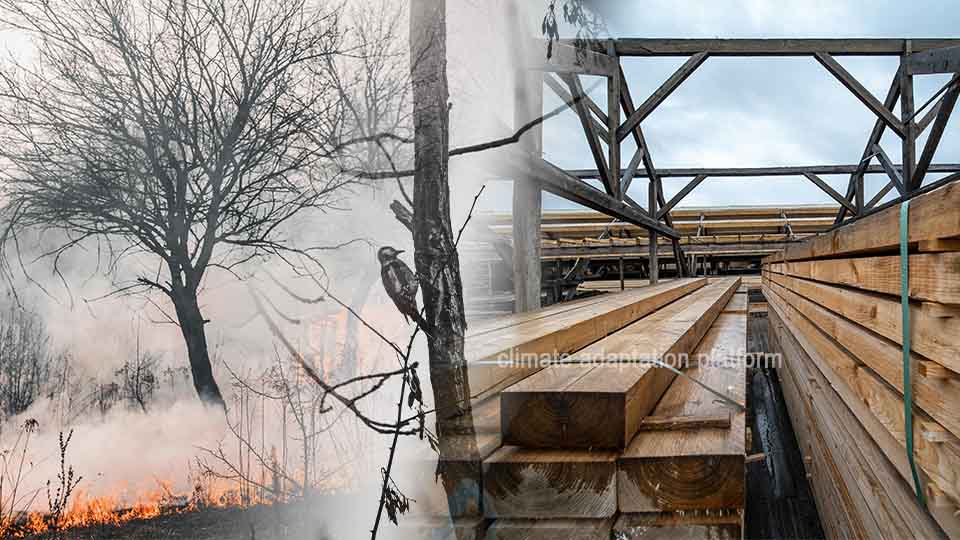
A Canadian company planning to build two of the country’s largest wood pellet mills aims to use trees from burned forests to produce wood pellets, sparking debate among scientists, environmentalists, and industry experts.
Canada has experienced increasingly severe and widespread wildfires in recent years. According to the Canadian Wildland Fire Information System, the country experiences around 3,000 lightning-caused wildfires annually, accounting for roughly half of all wildfires and the largest proportion of burned land. Although lightning strikes can occur throughout the year, their impacts are most severe during the hot and dry summer months, particularly in July and August.
As Canada enters the 2026 summer wildfire season, the country has just emerged from three consecutive years of severe fires. The 2025 wildfire season was the second-worst in Canadian history, with more than 6,000 wildfires burning over 8.3 million hectares across nearly every province and territory. Only the devastating 2023 wildfire season, which burned approximately 150,000 square kilometres of land, surpassed it.
With another summer beginning, concerns remain about how severe the 2026 wildfire season could become.
Wood pellets as a climate solution?
According to an article by The Tyee, the wood pellet company argues that recently burned forests can provide a reliable source of timber while helping restore damaged landscapes more quickly. The company claims that without intervention, natural reforestation could take more than two decades.
The company argues that harvesting burned trees and converting them into wood pellets represents an environmental “win-win”. It maintains that wood pellets provide a cleaner alternative to coal, oil, and natural gas because emissions from combustion can be offset by reforestation and new tree growth.
However, scientists dispute these claims. Some point to a 2022 study showing that burning wood can produce more carbon emissions per kilowatt-hour than coal. Others note that wood has a lower energy density than coal, meaning larger quantities must be burned to generate the same amount of energy.
The ecological value of burned forests
Researchers also stress that burned forests remain ecologically valuable. Scientists argue that many forests recover naturally within a few years, with new saplings emerging and creating habitat for wildlife such as moose and other species.
Post-fire forests also become important habitats for birds, including woodpeckers, chickadees, bluebirds, and starlings, which rely on tree cavities for nesting. Insects such as bees and wasps also benefit from these environments. According to scientists, burned forests often support unique biodiversity and ecological processes that should not be overlooked.
Critics further warn that although wood pellet companies claim they use only burned timber and forestry waste, rising demand may eventually lead to broader logging activities with long-term environmental consequences.
Alberta pellet mills and indigenous partnerships
The company behind the proposal, Powerwood Canada Corp., plans to construct two mills in northern Alberta. Chief Executive Officer David Peters argues that dead and decaying trees left after wildfires will eventually release greenhouse gases into the atmosphere. Converting them into wood pellets, he says, offers a more productive use of the material while supporting emissions reduction efforts.
The company claims its wood pellets could reduce carbon emissions by up to 98.7 per cent compared with coal. It also argues that reforestation efforts linked to logging operations could create new carbon sinks.
Powerwood Canada Corp., a subsidiary of CoAlternative Energy Ltd, plans to produce 700,000 tonnes of wood pellets annually. Some of these pellets are expected to be exported to Japan, where biomass energy production expanded following the 2011 earthquake and tsunami that triggered the Fukushima nuclear disaster and reshaped the country’s energy strategy.
The company says it is also working with Indigenous organisations and First Nations communities in northern Alberta to create employment opportunities in logging, transport, and milling. Once operational, the mills are expected to support around 500 jobs across the supply chain.
Balancing climate goals and biodiversity
The debate surrounding the logging of Canada’s burned forests highlights a broader challenge in balancing climate mitigation, biodiversity protection, and economic development.
Allowing burned forests to recover naturally helps preserve post-fire ecosystems and wildlife habitats. However, supporters of salvage logging argue that decaying timber may release greenhouse gases over time and that wood pellets can help reduce dependence on fossil fuels.
Critics counter that large-scale logging risks damaging fragile ecosystems and undermining natural recovery processes.
Ultimately, governments and policymakers face a complex decision: whether to prioritise natural forest regeneration or use burned timber as part of the transition away from fossil fuels.
The outcome will depend on how countries balance environmental protection, climate goals, and community livelihoods.
Source:
Wildfire Facts. (2021). Canada Wildfire. Retrieved from https://www.canadawildfire.org/wildfirefacts#:~:text=While%20human%20activities%20are%20responsible,wildfires%20and%20result%20in%20the
Parfitt, B. (14 April 2026). The Tyee. Retrieved from https://thetyee.ca/Analysis/2026/04/13/Does-Burning-Wood-Fight-Climate-Change/
Omstead, J. (2026, April 10). Canada is coming off 3 consecutive severe fire years. There are concerning signs for 2026. CBC. Retrieved from https://www.cbc.ca/news/science/wildfire-outlook-canada-2026-9.7158913
Government of Canada provides update on 2025 wildfires as support continues. (2025, October 30). Government of Canada. Retrieved from https://www.canada.ca/en/public-safety-canada/news/2025/10/government-of-canada-provides-update-on-2025-wildfires-as-support-continues.html
Leave a Reply