

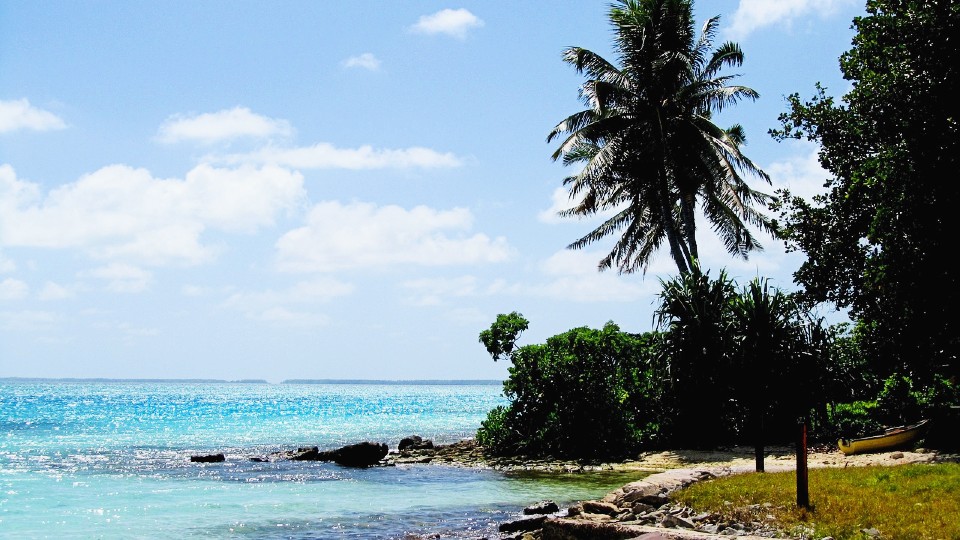
The tuna industry is critical to Kiribati’s economy. More than 70% of government revenue comes from selling fishing licences to foreign fleets – the highest proportion of any country in the world. In 2024 alone, Kiribati generated US$137 million from these licences, which officials describe as a “critical financial lifeline”.
Kiribati is an island nation in the central Pacific Ocean made up of 33 islands, of which only 21 are inhabited. Although its land area is relatively small – around 811 square kilometres, roughly the size of New York City – its Exclusive Economic Zone (EEZ) spans approximately 3 million square kilometres of ocean. These waters surround the country’s three island groups: the Gilbert, Phoenix, and Line Islands.
Kiribati’s waters are rich in marine life, particularly skipjack, yellowfin, and bigeye tuna. Globally, the tuna industry is valued at around US$44 billion annually and is expected to continue growing as demand for convenient, protein-rich foods increases.
According to the BBC, Kiribati benefits financially from its tuna-rich waters by selling fishing licences to countries including Japan, China, the United States, and members of the European Union. Riibeta Abeta, Permanent Secretary for Kiribati’s Ministry of Fisheries, described the licence revenue as a “critical financial lifeline”. Between 2018 and 2022, fishing licence fees contributed nearly three-quarters of government revenue and accounted for around 40% of the country’s GDP.
Simon Diffey, a fisheries specialist with more than three decades of experience in Kiribati, estimates that more than half of the world’s canned tuna comes from the Western and Central Pacific Ocean, where Kiribati and Papua New Guinea are located. However, unlike Papua New Guinea, which has larger land resources and a more diversified economy, Kiribati remains heavily dependent on fisheries.
Climate change threatens tuna stocks
Climate change is posing serious risks to Kiribati’s economy and food security. Rising sea levels and warming ocean temperatures threaten both the country’s islands and its tuna industry.
Kiribati’s highest point above sea level is less than two metres, leaving the country highly vulnerable to coastal erosion and flooding. With limited land and few natural resources beyond fisheries, the nation depends heavily on the ocean for both income and food.
Tuna species are highly sensitive to changes in ocean temperatures. Scientists warn that even small increases in water temperature can push tuna populations towards cooler waters outside Kiribati’s EEZ. If tuna stocks migrate elsewhere, the country could lose a substantial portion of its fishing licence revenue.
Kiribati’s Ministry of Fisheries says preliminary modelling suggests the country could lose more than US$10 million annually in fishing access fees by 2050 if global greenhouse gas emissions remain high. Under lower-emissions scenarios, however, tuna biomass within Kiribati’s waters is expected to remain more stable.
Local fishers are also likely to face declining catches regardless of the emissions scenario, according to the Pacific Community. The Line Islands are expected to be among the hardest-hit areas.
Food security and economic challenges
Declining fish stocks could significantly affect food security in Kiribati, where fish is a dietary staple. While people in countries such as the United States and Japan consume around 9 and 22 kilograms of fish per person annually, respectively, people in Kiribati consume approximately 100 kilograms per person each year.
As the country’s population grows, reliance on imported foods is expected to increase. However, imported products are often more expensive and less nutritious, creating additional health and economic pressures for local communities.
To help Pacific nations respond to climate threats, the Green Climate Fund has launched a US$156.8 million regional programme to strengthen climate adaptation across 14 Pacific countries. The initiative includes support for early warning systems that track shifting tuna stocks and measures to improve food security through alternative fisheries.
Meanwhile, the government of Kiribati is attempting to diversify its economy and reduce dependence on fishing licence revenues. Officials say the country is expanding domestic tuna processing and canning facilities to capture more value locally.
Kiribati is also developing aquaculture industries involving species such as milkfish, snapper, and sea cucumbers to support exports and domestic food supplies. Additional diversification efforts include tourism, renewable energy, and offshore sovereign wealth investments.
A fragile future for a tuna-dependent nation
Kiribati’s heavy reliance on tuna revenues highlights the challenges small island nations face as climate change reshapes marine ecosystems and economic stability.
While the tuna industry remains a vital financial lifeline, shifting fish stocks, rising seas, and growing food security concerns underscore the urgent need for climate adaptation and economic diversification.
The country’s future resilience may depend on how successfully it can balance fisheries management, climate adaptation, and sustainable development.
Sources:
Evans, J. (2026, October 28). How climate change threatens the economic backbone of the Pacific. BBC. Retrieved from https://www.bbc.com/news/articles/cq57vxjvdy4o
Tuna Fish Market. (2026, April 13). Fortune Business Insight. Retrieved from https://www.fortunebusinessinsights.com/industry-reports/tuna-fish-market-100744
Towards sustainable fish value chains for domestic tuna in Kiribati. (2025). FAO. Retrieved from https://www.fao.org/fishery/fr/publications/323281
Leave a Reply