

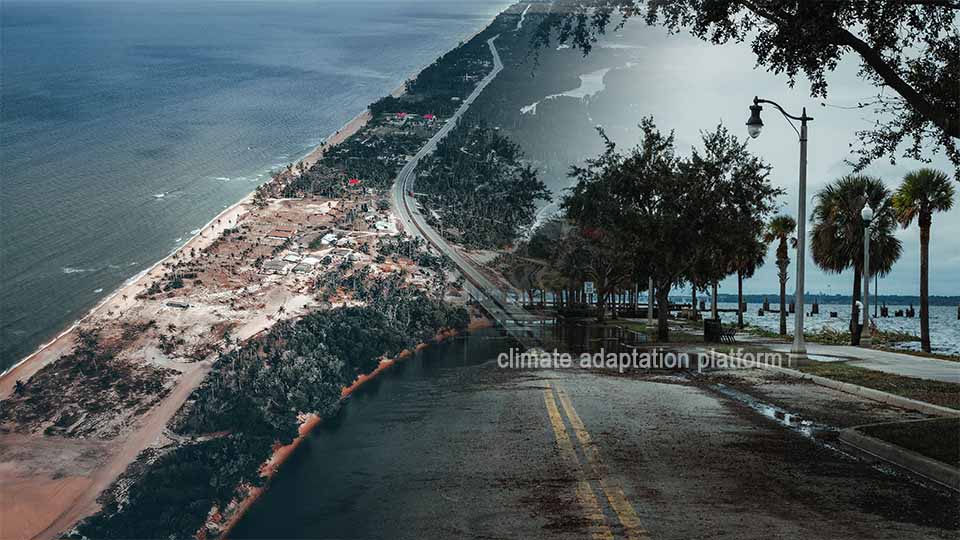
As global temperatures are likely to exceed the Paris Agreement target of 1.5°C, sea levels are expected to continue rising for a long time.
In the past, similar warmth led to major ice-sheet loss, so low-lying coastal areas are now facing much higher sea-level risks than current planning usually assumes.
Louisiana’s coastlines are retreating rapidly due to sea-level rise and are already driving more people out of the area. The state’s coastline is among the most exposed in the world, and it is projected that its shoreline will move 30 miles inland, and by 2070, it will lose 75% of its remaining wetlands.
Depopulation in the state’s coastal communities has been significant since Hurricane Katrina, an extremely powerful and destructive storm that hit the state in August 2005. It was responsible for 1833 deaths and approximately $108 billion in damage. Since Hurricane Katrina, about a quarter of the residents of Orleans Parish had left, and more than half had relocated from rural Cameron Parish.
A study from an interdisciplinary team of scientists from Tulane University, Florida State University, and Coastal Carolina University published in Nature Sustainability, “Climate-driven depopulation and adaptation realities in America’s coastal ground zero” examines how sea level rise, land loss, and extreme weather events are driving people to leave Louisiana’s coastal area, and how they might be able this early state depopulation can shape long term climate adaptation plans and strategies.
The authors have analysed a trend showing that Louisiana’s coastal areas are losing population since 2002 and argue that climate-driven depopulation is already happening, so they treat Louisiana’s coastal communities as “ground zero” case, whose experience on how depopulation takes place will become a preview for other coastal areas facing the same threats. The state’s ongoing depopulation is also creating a “first-mover advantage” in testing and refining policies and strategies to relocate households, infrastructure, and businesses to support successful climate adaptation.
The study examined both historical and archaeological evidence, including Indigenous migration patterns in the delta, to understand what is happening. For instance, archaeological evidence shows Indigenous communities historically adapted to environmental change by relocating along the coast. Drawing on the past and early patterns of human movement can inform climate adaptation strategies for today’s coastal communities.
By accepting that the shoreline’s retreat is inevitable, the state can now begin planning for a managed relocation – an orderly, multigenerational movement of people and infrastructure to higher ground, setting an example for the world’s coastal communities to follow.
“Transition planning offers significant first-mover opportunities, including the development of innovations in infrastructure and housing that are affordable for people on the move,” said study coauthor Jesse Keenan, the Favrot II Associate Professor in Tulane’s School of Architecture and Built Environment (Louisiana’s Shrinking Coast, 2026).
Sources
Törnqvist, T.E., Castro, B., Keenan, J.M. et al. Climate-driven depopulation and adaptation realities in America’s coastal ground zero. Nat Sustain (2026). https://doi.org/10.1038/s41893-026-01820-z
Louisiana’s Shrinking Coast Offers a Narrowing Window for Managed Retreat. (2026, May 4). Yale School for the Environment. Retrieved from https://environment.yale.edu/news/article/louisianas-shrinking-coast-offers-narrowing-window-managed-retreat
Harley, S. & Egan, R. (2026, May 4). Louisiana’s shrinking coast may offer world early guide to climate adaptation. Phys.org. Retrieved from https://phys.org/news/2026-05-louisiana-coast-world-early-climate.html
Leave a Reply