

Deserts dominate the land surface of the Middle East. Open a satellite map, and it will show swathes of beige, the Arabian Desert stretching from Saudi Arabia, spilling into Oman, the UAE, and neighbouring states.
In an arid climate, fresh water is as valuable as, or even more valuable than, oil. Countries like the United Arab Emirates (UAE) rely on expensive desalination plants and cloud seeding campaigns to meet their freshwater needs.
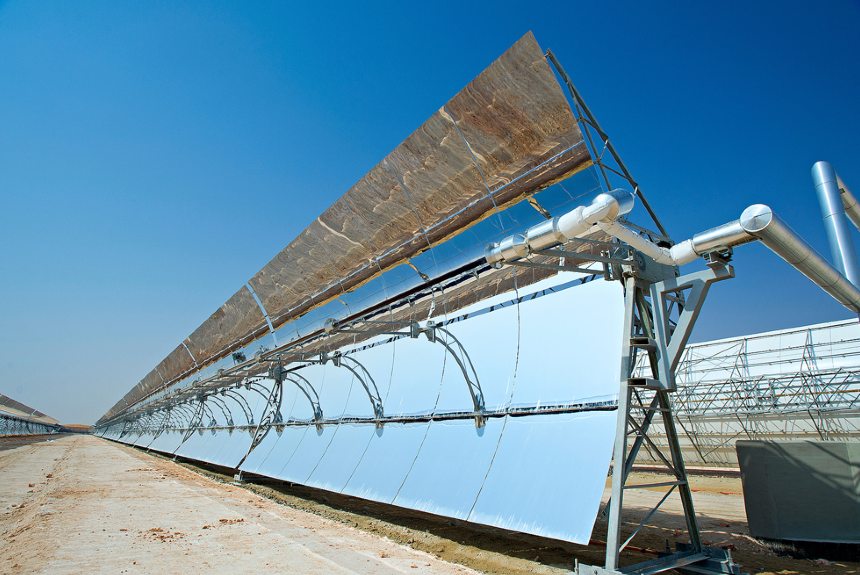
The vastness of deserts, their flat terrain, and the abundant sunlight they receive make them ideal sites for solar farms. Solar energy is now dominating new power capacity, with the trend expected to continue.
According to the IEA 2025 report, solar PV will account for around 80% of the global increase in renewable power capacity over the next five years, driven by low costs and faster permitting timeframes.
In addition to generating renewable energy, solar farms offer another benefit to these arid regions.
A study, “Scaling artificial heat islands to enhance precipitation in the United Arab Emirates”, published in the Earth System Dynamics journal, finds that large solar farms can increase rainfall and make more plants grow in the desert.
‘A dark surface on a solar panel gets very hot when hit by the sun’s rays, releasing heat into the air. The hot land air rises rapidly, creating a “suction” effect that lowers air pressure near the ground. Cooler, higher-pressure air from the ocean rushes in to fill the gap, carrying a lot of water vapour.
The study simulated various sizes of “artificial black surfaces” (ABS) made from dark solar panels, with surface areas ranging from 10 to 50 kilometres. Their simulation shows that large black surfaces of 20 kilometres or more could trigger more rainfall by making it easier for rain clouds to form. The larger the surface area, the more it boosts rainfall. The smallest, with a 10-kilometre-square surface area, had little effect.
A 20-kilometre ABS increased average daily rainfall by approximately 571,616 cubic meters compared to scenarios without ABS. Surfaces of 30, 40, and 50 kilometres increased rainfall by about 1 million, 1.5 million, and 2.3 million cubic meters per day, respectively.
If rainfall occurs only 10 days per year, this additional water could supply over 31,000, 50,000, 79,000, and 125,000 people annually, based on UAE water usage. The study suggests that artificial black surfaces, such as dark solar panels, could help increase rainfall in arid regions like the UAE and recommends further research.
While large solar farms in the Middle East deserts could trigger rainfall, bringing the much-needed moisture to the arid region and effectively greening the desert, another study cautioned about the adverse effects of large swaths of solar farms in the Middle East desert.
The 2020 study published in the Geophysical Research Letters Journal shows that while building large solar farms of up to more than 1 million square kilometres in the Sahara desert could increase local rainfall and cause vegetation to flourish and generate power that is badly needed in African countries, these benefits could trigger negative effects in other parts of the world.
Using climate models, they find that these solar farms would alter wind patterns, pushing the tropical rain bands northward, which accounts for more than 30% of global precipitation and supports the Amazon and Congo Basin rainforests. If this happens, it could lead to droughts and forest loss in the Amazon.
The rainfall the Sahara receives is roughly equal to the rainfall the Amazon loses. Additionally, large swaths of solar farms could raise global temperatures, reduce Arctic sea ice, and push forests farther north.
The strength of natural climate patterns like El Niño and the Atlantic Niño might weaken. At the same time, tropical storms could become more intense, hitting the coastlines of North America and East Asia.
Interestingly, the study notes that these results resemble those from about 6,000 years ago, when the Sahara was wetter and greener.
However, these effects will depend on the size of solar farms. Smaller installations will not have the same feedback dynamics, emphasising that there is a threshold beyond which the solar panels cease being a climate adaptation solution and become maladaptive, leading to outcomes the solution aims to address in the first place.
The study concludes that understanding these global responses can help guide where and how massive solar projects should be built.
Sources
Long, J., Lu, Z., Miller, P.A. et al. Large-scale photovoltaic solar farms in the Sahara affect solar power generation potential globally. Commun Earth Environ 5, 11 (2024). https://doi.org/10.1038/s43247-023-01117-5
Lu, Z., Zhang, Q., Miller, P. A., Zhang, Q., Berntell, E., & Smith, B. (2021). Impacts of Large-Scale Sahara Solar Farms on Global Climate and Vegetation Cover. Geophysical Research Letters, 48(2), e2020GL090789. https://doi.org/10.1029/2020GL090789
Voosen, P. (2024, February 6). Massive solar farms could provoke rainclouds in the desert. Science. Retrieved from https://www.science.org/content/article/massive-solar-farms-could-provoke-rainclouds-desert
Leave a Reply