

Aotearoa New Zealand is highly exposed to natural hazards, including earthquakes, volcanic activity, and climate-related events such as floods and storms.
Auckland, like many large cities, is culturally diverse. People from diverse backgrounds and ethnicities flock to urban areas for the greater opportunities they offer.
The concentration of population, infrastructure, assets, and businesses also increases cities’ vulnerability to climate-related hazards. To effectively reduce risk, it is important to understand how different groups perceive and respond to risk.
The study, “Why we see risk differently: Socioeconomic dimensions of climate hazard and risk perceptions in Auckland, New Zealand”, by researchers from the University of Auckland, investigates how Auckland residents perceive climate hazard risks and how these perceptions differ across socio-economic groups. Understanding how diverse individuals perceive these risks is crucial for designing effective disaster risk reduction strategies.
The study surveyed 206 residents in Henderson-Massey, in West Auckland, one of New Zealand’s most demographically varied urban regions.
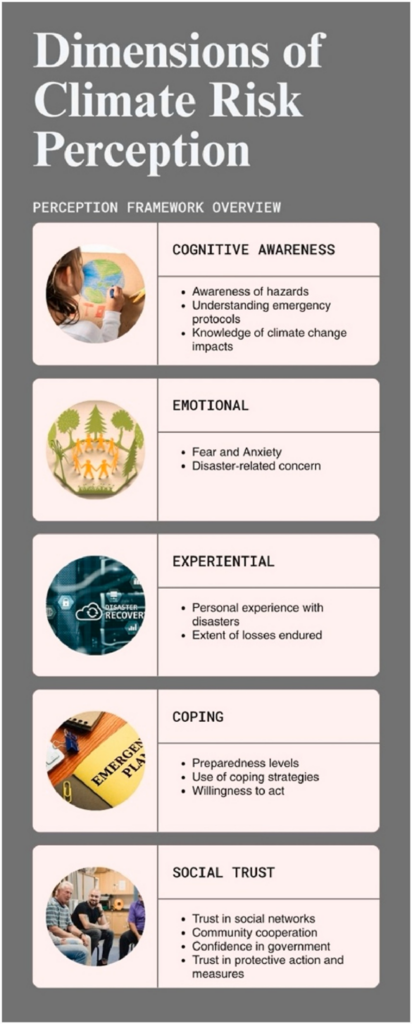
Researchers constructed a five-part Risk Perception Index encompassing cognitive (individuals’ awareness and understanding of hazards), emotional (affective responses such as fear and anxiety), experiential (the influence of prior direct or indirect experiences with disasters), coping (their perceived ability and willingness to take protective actions or self-efficacy), and social trust dimensions (trust in social networks and institutional responses).
Then, using statistical analysis, they explored how socio-economic factors such as age, gender, education, income, ethnicity, housing tenure, and place attachment influence respondents’ overall risk perception and each of the five dimensions.
The image is taken from the study, which shows the five dimensions of risk perception operationalised in the survey:
The results of the study’s analysis of the influence of socio-economic factors on respondents’ perceptions of risk across various dimensions are as follows.
Overall Risk Perception
When it comes to overall risk perception, the results show that ethnicity is positively associated with it, particularly among those identifying as Māori or Pacific Islander, reflecting heightened awareness of or greater historical exposure to disasters such as floods and landslides in the study area.
Respondents from higher-income households and those with more stable or higher-tier jobs tended to perceive lower overall risk. Additionally, individuals with stronger emotional or social ties to Henderson-Massey, the study area, are more likely to be classified as having ‘high risk perception,’ possibly due to their heightened concern for community safety and local environment.
Cognitive Dimension
Analysing results across the various risk perception dimensions shows that, regarding cognitive perceptions of risk, Mandri or Pacific Islander respondents rated themselves higher in disaster awareness and related knowledge.
Homeownership also shows a positive correlation with cognitive risk perception, indicating that homeowners are more concerned about the risks to their properties and may proactively seek preparedness knowledge.
Emotional Dimension
When it comes to respondent’s levels of anxiety, fear, and concern about the frequency of future disasters, older respondents tended to exhibit lower emotional distress or anxiety about disasters.
This could be attributed to a greater experience and psychological adaptation over time. In contrast, Māori and Pacific Islanders had heightened emotional responses to disaster risks.
Additionally, those in higher-income households are less emotionally sensitive to potential disaster risks.
Experiential Dimension
This dimension assessed whether respondents had directly experienced disasters or suffered losses as a result. The results show that older respondents, households with higher education levels, and higher-income households are positively correlated with the experiential dimension index.
This indicates that older respondents are more likely to report having experienced disasters due to their age, more educated individuals are either more sensitive to past disasters or more inclined to recall and report such experiences, and higher-income households may not feel more anxious, but they are more likely to have experienced tangible disaster-related losses—perhaps due to owning more assets that are vulnerable to damage.
Coping Dimension
Ethnicity has a strong and positive correlation with the coping dimension, meaning that Māori or Pacific Islander groups were not only more perceptive and emotionally responsive to risks but also more proactive in undertaking preparedness measures or with stronger coping intentions.
Possible underlying mechanisms included cultural emphasis on community support, intergenerational disaster awareness, and heightened perception of vulnerability, which contribute to greater readiness.
Social Trust and Support Dimension
The results for the social trust and support dimension showed a negative correlation with gender, particularly among women, Māori, and Pacific Islander respondents, and with the length of time living in the areas (long-term residents). This means that lower levels of trust in government, community, and neighbours, or greater caution about social safety nets, are associated with this outcome.
While Māori or Pacific Islander respondents may be more active in perception and coping, they still harbour doubts about whether public or community institutions can provide sufficient disaster support.
Women reported lower levels of trust in government, community, and neighbours, or were more cautious about social safety nets; lastly, long-term residents of Henderson-Massey may hold more sceptical views about the reliability of local institutions or collective action, indicating a mix of accumulated positive and negative experiences.
The results show clear differences between groups. Māori and Pacific Islander participants tend to have higher awareness, stronger emotional responses, and greater willingness to act, but lower trust in formal institutions.
People with higher income and education report greater exposure to hazards and feel more able to cope. Lower-income and female respondents report higher emotional stress.
The study also finds a “risk perception paradox,” in which people with greater exposure to hazards are not always more concerned or prepared.
Based on these findings, the study presented the following recommendations:
- Co-produce risk communication materials with indigenous and marginalised groups such as Māori and Pacific Islander leaders to align messages with community narratives and rebuild trust.
- Address institutional barriers to participation, including culturally inappropriate services and underrepresentation in governance.
- Enhance social support infrastructure in low-income and high-risk neighbourhoods to reduce emotional and psychological vulnerability.
- Recognise lived experience—particularly of older residents and those with deep local roots as a form of hazard expertise to be embedded in planning.
The author notes that their findings offer actionable insights for policymakers, urban planners, and emergency management agencies, helping them anticipate risk perception across diverse communities and design more targeted, equitable, and effective risk communication strategies and resilience-building initiatives tailored to urban contexts similar to Henderson-Massey.
Learn more about the study: Why we see risk differently: Socioeconomic dimensions of climate hazard and risk perceptions in Auckland, New Zealand
Source
Jayawardena, I., Mannakkara, S., Wang, G., & Wen, L. (2026). Why we see risk differently: Socioeconomic dimensions of climate hazard and risk perceptions in Auckland, New Zealand. International Journal of Disaster Risk Reduction, 133, 106011. https://doi.org/10.1016/j.ijdrr.2026.106011
Leave a Reply