

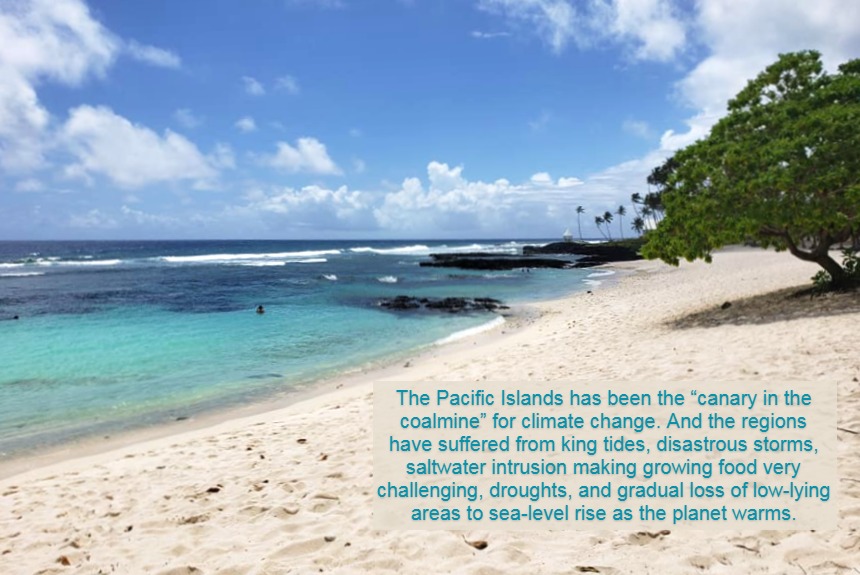
Pacific Island countries are widely recognised for their high climate vulnerability and exposure to natural hazards. As a result, Disaster Risk Reduction (DRR) and Climate Change Adaptation (CCA) have become essential strategies for reducing the impacts of climate change across the region.
In the Pacific Islands, donor funding plays a major role in shaping climate adaptation efforts. By 2021, the region had received more than US$2.3 billion in climate finance, with most funding delivered through Overseas Development Assistance (ODA) and implemented via International Development Projects (IDPs). While Pacific Island countries face severe climate risks, their local knowledge (LK) remains deeply connected to culture, history, and community relationships.
However, donor-funded CCA and DRR projects often fail to fully integrate local knowledge, despite its recognised value. Instead, local knowledge is frequently treated as secondary to Western Scientific Knowledge (WSK), which is often viewed as more authoritative and has become institutionalised within development planning and disaster management systems. As a result, local knowledge is commonly sidelined or treated as an optional add-on, reducing both its effectiveness and long-term value.
Given this imbalance, an important question emerges: how can donor-funded climate adaptation and disaster risk reduction projects move beyond external, technical approaches and meaningfully incorporate local knowledge into the design, implementation, and governance of resilience initiatives? Local communities often possess the deepest understanding of their environments, hazards, and adaptation needs.
The weave framework and knowledge integration
The paper, “Weave framework: harnessing local knowledge in donor-funded climate change adaptation and disaster risk reduction projects”, co-authored by Dr Theuns Henning, Director of the Infrastructure Management Post-Graduate Programme at the University of Auckland, and a team leader at the Climate Adaptation Platform, explores how local and Western scientific knowledge can be integrated more fairly and equitably in donor-funded climate and disaster projects.
The paper introduces the Weave Framework, described as “a diagnostic and analytical tool designed to examine how epistemology, relational scale and donor governance interact to shape knowledge interplay”.
Rather than treating knowledge integration as merely a methodological challenge, the framework examines how power structures, institutional systems, and donor-driven project cycles influence whose knowledge is prioritised. The framework is intended to complement existing integration models by offering a more structured way to critically assess the realities of donor-funded adaptation projects in Pacific Island contexts.
Three key themes shaping knowledge interplay
Using an extensive review of existing literature, the authors identify three major themes that shape how knowledge is produced, valued, and applied within CCA and DRR projects.
Philosophical Foundations
This theme examines the underlying assumptions and belief systems that determine how knowledge is defined, valued, and ranked within climate adaptation and disaster risk reduction.
Application Challenges
When one form of knowledge is viewed as superior, this belief often influences how donor-funded projects are designed, governed, and implemented. This can marginalise local voices and reduce the effectiveness of adaptation efforts.
Methodological Considerations
The study also highlights how research methods and evaluation systems shape what is recognised as valid knowledge, whose perspectives are documented, and how information becomes acceptable within donor systems. These methodological choices influence representation, authority, and inclusion in climate adaptation processes.
Together, these themes demonstrate that knowledge integration is shaped not only by what counts as knowledge but also by the institutional structures and practical methods through which knowledge is produced, interpreted, and applied.
Promoting more inclusive climate adaptation
The Weave Framework promotes equitable and context-specific collaboration across different levels of decision-making:
- Macro level – donors and international development partners
- Meso level – government institutions and private-sector experts
- Micro level – local communities and grassroots organisations
The framework encourages treating both local knowledge and Western scientific knowledge as dynamic and equally valuable systems. This approach enables governments, donors, and communities to co-design more inclusive and effective climate adaptation strategies.
According to Noora Yukich, lead author of the study and doctoral candidate in Civil and Environmental Engineering at the University of Auckland:
“This framework was shaped not only by academic research, but by years of working within the realities of donor-funded climate and resilience projects in the Pacific.”
The study highlights the importance of rethinking how climate adaptation projects are designed and governed, particularly in highly vulnerable regions where local communities possess critical environmental knowledge and lived experience.
Learn more about the paper: Weave framework: harnessing local knowledge in donor-funded climate change adaptation and disaster risk reduction projects.
Source
Noora Yukich, Sandeeka Mannakkara & Theunis F. P. Henning (28 Apr 2026): Weave framework: harnessing local knowledge in donor-funded climate change adaptation and disaster risk reduction projects, Climate and Development, DOI: 10.1080/17565529.2026.2661681
Leave a Reply