

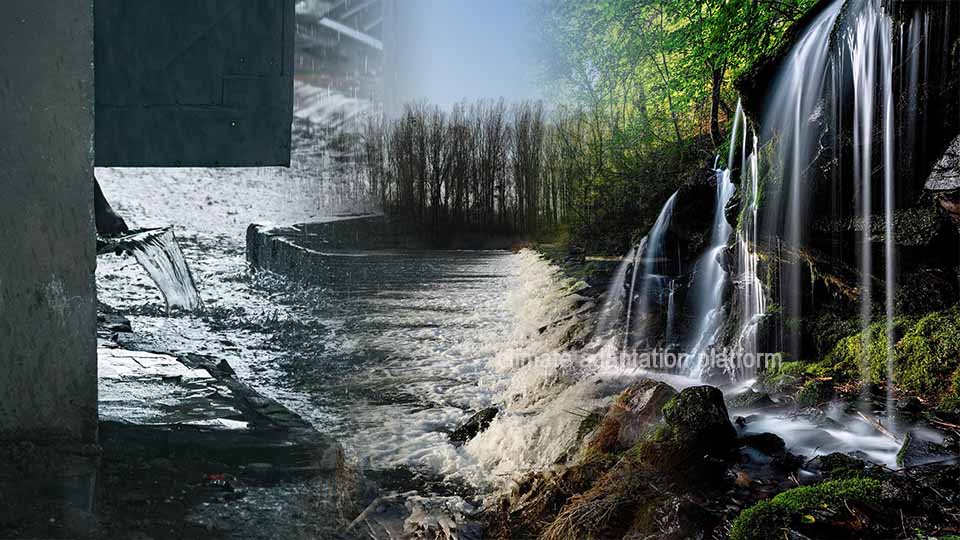
Urban runoff brings heavy metals into rivers and ecosystems, causing harm. Metals such as Cadmium, Chromium, Copper, Nickel, Lead, and Zinc often enter waterways in cities during rain or snowmelt.
These metals are toxic, can accumulate in living things, and persist in the environment for long periods, affecting both aquatic life and people. Sources include car emissions, construction, fertilisers, and the atmosphere.
Heavy metals are usually dissolved in water, making them easier for organisms to absorb, and they often stick to fine particles. How much metal ends up in runoff depends on how much it rains.
Geen infrastructure (GI) is a promising approach for managing heavy metals in urban stormwater. Unlike traditional grey infrastructure like gutters and pipes, GI uses natural elements such as soil, plants, and microbes to clean rainwater right at its source. One type of GI, called a bioretention cell or rain garden, is a shallow depression that helps reduce stormwater and improve its quality by filtering runoff through soil and plant roots.
The City of Columbus, Ohio, started using Green Infrastructure (GI) in existing developments to improve water management and reduce sewer overflows. In 2005, Columbus entered into agreements with the Ohio EPA to address these problems. By 2009, the city planned to build underground tunnels and expand wastewater treatment.
In 2012, after advice from the US EPA, the plan was updated to include GI, especially in parts of Columbus with separate sewer systems. The Ohio EPA approved this change and chose the Clintonville neighbourhood to test the new approach, called Blueprint Columbus.
The study published in the Journal of Hazardous Materials, “Retrofitted watershed scale green infrastructure reduces heavy metals in urban stormwater from residential land use” on 15 October 2025, examines how installing “green infrastructure” (GI) at the watershed scale can affect the amount of heavy metals in urban stormwater runoff from residential areas.
As part of the project Blueprint Columbus, a 30-year community effort to install green infrastructure in local neighbourhoods, the study investigates the performance of two watersheds in the Clintonville neighbourhood of Columbus in managing stormwater pollution for about 3.5 years.
The three watersheds include Beechwold, Cooke-Glenmont, and Indian Springs in the Clintonville neighbourhood of Columbus, Ohio, USA, for stormwater hydrology and water quality at their respective storm sewer outfalls. Beechwold was the control watershed, and Cooke-Glenmont and Indian Springs were the treatment watersheds.
The study comparing the control watersheds, one without a GI, to the two treatment watersheds showed robust evidence that the presence of GI has reduced storm water runoff, improved water quality, and reduced the amounts of heavy metals in entering the waterways, particularly in the Cooke-Glenmont treatment watersheds with an area of 11.5 hectares where it has shown a significant reductions in copper (33.6%), nickel (46%), cadmium (44%), zinc (5.9%), due to the influence of two large bioretention cells and a smaller one.
These reductions in heavy metals are not due to seasonal or annual climate fluctuations, but are attributed to the installation of GI. Green infrastructure reduced heavy metal concentrations in downstream waterways and ecosystems by capturing and treating them through sedimentation, filtration, sorption, and biological uptake within the GI. GI also has the potential to improve residents’ wellbeing and enhance biodiversity in the area.
However, another treatment watershed, with an area of 47.8 hectares, comprising 32 offline bioretention cells and four permeable pavement roads, did not show any reduction in heavy metal concentrations following the GI retrofits. The study suggested that this lack of improvement was due to design and implementation issues.
The study recommends using online bioretention cells in series, optimising their design, and ensuring proper maintenance to increase efficiency. It also highlights engaging with local communities early in the process as a key strategy for improving public support for GI installations. Overall, the study finds that a well-designed and well-maintained GI system in residential areas can help reduce heavy metal levels in nearby waterways.
In summary, adding more of these systems in cities could make urban ecosystems healthier and stronger, according to the study’s lead author, Joseph Smith. “Not only does green infrastructure improve water quality, but it also helps cities to be cooler because it adds more green space. The goal is to design spaces where people want to walk around and enjoy beautiful surroundings and experience the many ecosystem services created,” he said.
Source:
Smith, J. S., Bernard, K., Boening-Ulman, K. M., Martin, J. F., Tirpak, R. A., Wituszynski, D. M., & Winston, R. J. (2025). Retrofitted watershed scale green infrastructure reduces heavy metals in urban stormwater from residential land use. Journal of Hazardous Materials, 498, 139808. https://doi.org/10.1016/j.jhazmat.2025.139808
Woodall, T. (2025, October 15). How green infrastructure is revamping city storm sewers. Ohio State News. Retrieved from https://news.osu.edu/how-green-infrastructure-is-revamping-city-storm-sewers/
Leave a Reply