

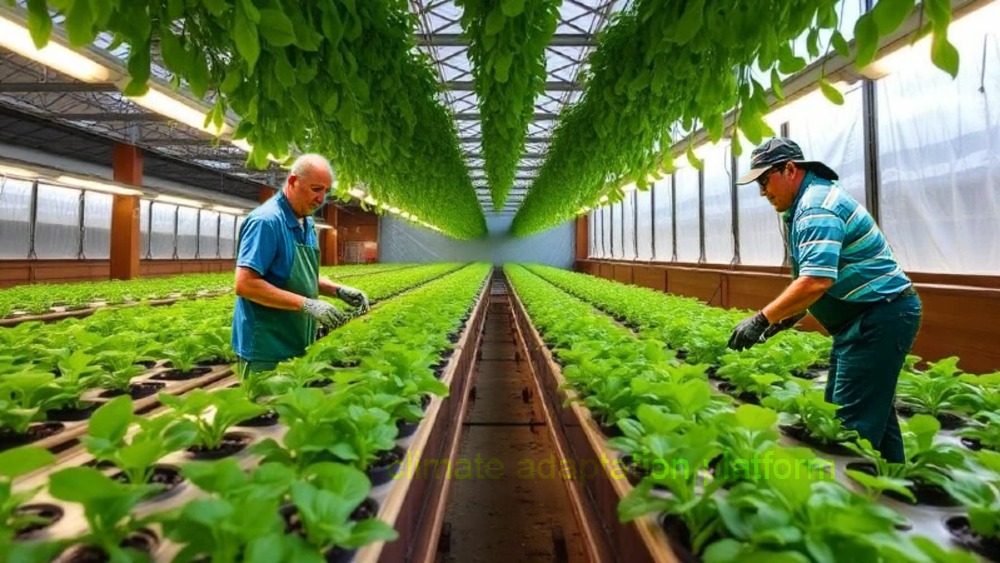
As droughts intensify and water supplies become increasingly strained, many regions are searching for innovative agricultural solutions.
One promising approach is hydroponic farming, which enables crop production using minimal water — a vital advantage for drought-prone or arid regions and for meeting rising global food demand.
Water stress and the need for smarter food production
Agriculture accounts for 70% of global freshwater use, and fruit and vegetable production requires large volumes of water to sustain crops.
As the climate warms, efficient water management is becoming essential for building a resilient food system that supports biodiversity, protects farmers’ livelihoods, and ensures food security.
New analysis from the World Resources Institute (WRI) reveals that one-quarter of the world’s crops are grown in areas with highly stressed or unreliable water supplies. Globally, irrigated crops represent just 34% of total agricultural production by weight, yet they contribute significantly to global food output. Rainfed crops — 66% of production — are far more vulnerable to weather extremes.
Climate change is driving longer and more frequent droughts, while deforestation disrupts rainfall patterns, making crop failure increasingly likely. Meanwhile, global food demand is rising sharply: research shows the world will need to produce 56% more food calories by 2050 to feed a projected 10 billion people.
Only ten countries produce 72% of the world’s irrigated crops, and two-thirds of these crops face high to extremely high water stress, posing a major risk to food security.
Hydroponics as a water-efficient alternative
Robert Brear’s article “Hydroponic Farming: Water Efficiency, Year-Round Production, and Sustainable Urban Solutions” highlights hydroponic farming as a sustainable solution, particularly in urban areas with limited space.
Hydroponic systems are highly water-efficient, using up to 90% less water than traditional farming because water is recirculated within the system rather than lost to soil absorption or evaporation.
Hydroponics also offers:
- Space optimisation – crops can be grown in compact or vertical systems, enabling high-density production.
- Year-round cultivation – controlled environments regulate light, temperature, and humidity.
- Fewer pests and diseases – reducing the need for chemical inputs.
- Urban integration – allowing food production close to consumers and transforming underutilised spaces such as warehouses or rooftops.
These advantages make hydroponics a potential game-changer for cities facing rapid population growth and land scarcity.
Hydroponics and the future of sustainable crop production
A 2023 study, “Hydroponics: current trends in sustainable crop production“, offers a comprehensive review of how hydroponic systems are advancing.
Key developments include:
- Soilless cultivation that delivers nutrients directly to plant roots, reducing water use.
- Integration of smart technologies such as IoT, sensors, and automation to monitor nutrients, moisture, and plant growth in real time.
- Enhanced precision farming, enabling farmers to optimise growing conditions and reduce waste.
The study notes that with 68% of the world’s population projected to live in cities by 2050, urban hydroponics can play a vital role in meeting rising food demand.
In regions experiencing widespread malnutrition, hydroponics also offers a pathway to greater food security by enabling local, reliable crop production regardless of climate conditions.
Source:
Saccoccia, L. & Kuzma, S. (2024, October 16). One-Quarter of World’s Crops Threatened by Water Risks. World Resource Institute. Retrieved from https://www.wri.org/insights/growing-water-risks-food-crops
Brears, R. (2024, November 28). Hydroponic Farming: Water Efficiency, Year-Round Production, and Sustainable Urban Solutions. Medium. Retrieved from https://medium.com/global-climate-solutions/hydroponic-farming-water-efficiency-year-round-production-and-sustainable-urban-solutions-1ee4640a4996
Rajaseger, G., Chan, K. L., Tan, K. Y., Ramasamy, S., Khin, M. C., Amaladoss, A., & Haribhai, P. K. (2023). Hydroponics: Current trends in sustainable crop production. Bioinformation, 19(9), 925. https://doi.org/10.6026/97320630019925
Leave a Reply