

Human life and well-being depend fundamentally on nature. From the water we drink and the food we eat to the air we breathe, natural resources underpin our survival, economies, and modern societies.
Healthy ecosystems and rich biodiversity are therefore essential for life on Earth. Yet rising demand for land, energy, and raw materials is placing unprecedented pressure on habitats, species, and the vital ecosystem services they provide.
At the same time, biodiversity loss is accelerating globally, with ecosystems declining at an alarming rate. In parallel with this crisis, the rapid advancement of artificial intelligence (AI) is transforming how societies collect, analyse, and act on information.
These two trends — biodiversity decline and technological acceleration — are unfolding simultaneously, presenting both risks and opportunities.
AI as an enabler for nature conservation
Artificial intelligence is more than an emerging technology; it is a foundational system that enables and accelerates other technologies such as robotics, the Internet of Things (IoT), and augmented reality.
While these technologies can collect and display vast amounts of data, AI enables them to analyse patterns, learn from information, and make decisions in near real time.
In the context of nature conservation, AI has the potential to be transformative. It allows governments, companies, scientists, and conservation organisations to collect and process enormous volumes of environmental data more efficiently, generate new insights, and translate those insights into targeted action.
AI can also support better planning and monitoring, helping to assess whether conservation measures are working once implemented.
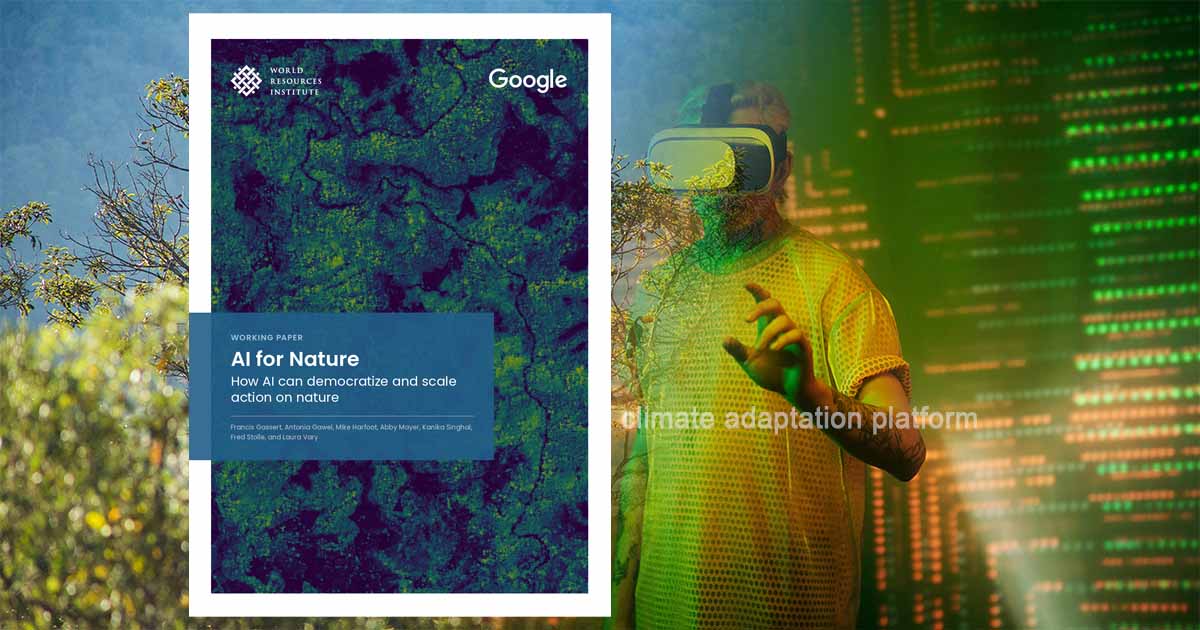
Google and WRI’s working “AI for Nature. How AI can democratize and scale action on nature” explores the role AI can play in overcoming key barriers to protecting biodiversity. The report outlines how AI can democratise and scale efforts to halt and reverse nature loss, while also identifying the risks that must be managed as these technologies expand.
AI monitoring tools transforming conservation efforts
The paper highlights several real-world examples of AI already supporting nature conservation through near-real-time monitoring of ecosystems.
iNaturalist is a citizen science platform that allows users to share species observations using photos and GPS data. A global community of experts and enthusiasts verifies these observations. With over 400,000 contributors, iNaturalist has generated more than 100 million research-grade records shared with the Global Biodiversity Information Facility. These data have enabled open-range maps for over 100,000 species and informed more than 6,500 scientific publications, strengthening conservation planning worldwide.
Global Fishing Watch, launched by Google, SkyTruth, and Oceana in 2015, uses AI to analyse vessel movement data and monitor fishing activity at sea. By identifying patterns associated with fishing behaviour, the platform helps detect illegal fishing, protect marine ecosystems, and strengthen fisheries governance. Its commitment to transparency — making data publicly accessible — has improved accountability and supported evidence-based ocean management.
Wildlife Insights is a cloud-based AI platform designed to process images from camera traps used in biodiversity monitoring. In species-rich regions, camera traps can capture over 100,000 images per month, making manual analysis slow and resource-intensive. Wildlife Insights uses computer vision to automatically identify species, remove empty images, and organise data efficiently. Its underlying AI tools, including MegaDetector and SpeciesNet, are open-source, allowing wider adoption and continual improvement.
Scaling AI for nature: Opportunities and risks
Drawing on interviews with 22 experts working at the intersection of AI and nature, as well as existing literature and case studies, the working paper adopts a user-centred perspective. It identifies current barriers to conservation action, demonstrates how AI is already addressing these challenges, and proposes ways to scale solutions responsibly.
AI tools can empower decision-makers, local communities, and civil society with actionable information to protect and restore ecosystems. However, access to AI technologies remains uneven, with many tools concentrated in a small number of countries.
Expanding access — particularly to biodiversity-rich regions most vulnerable to nature loss — is essential to avoid deepening global inequalities.
The report emphasises that Artificial Intelligence should be viewed as an enabler rather than a replacement for conservation expertise. To unlock its full potential, the authors recommend three priority actions: open primary data collection, open and accessible AI models, and capacity and knowledge sharing.
Together, these actions create a positive feedback loop in which better data leads to better models, open tools empower local actors, and strengthened capacity supports more effective, on-the-ground conservation efforts.
Source:
Gassert, F., Gawel, A., Harfoot, M., Mayer, A., Singhal, K., Stolle, F., & Vary, L. (2025, November). AI for Nature. How AI can democratize and scale action on nature. Retrieved from https://sustainability.google/reports/google-2025-AI-for-Nature/
Brandt, K., & Dasgupta, A. (2025, November 4). Unlocking AI’s transformative potential to protect and restore nature. Retrieved from https://blog.google/outreach-initiatives/sustainability/google-world-resources-institute-new-paper/?
Leave a Reply