

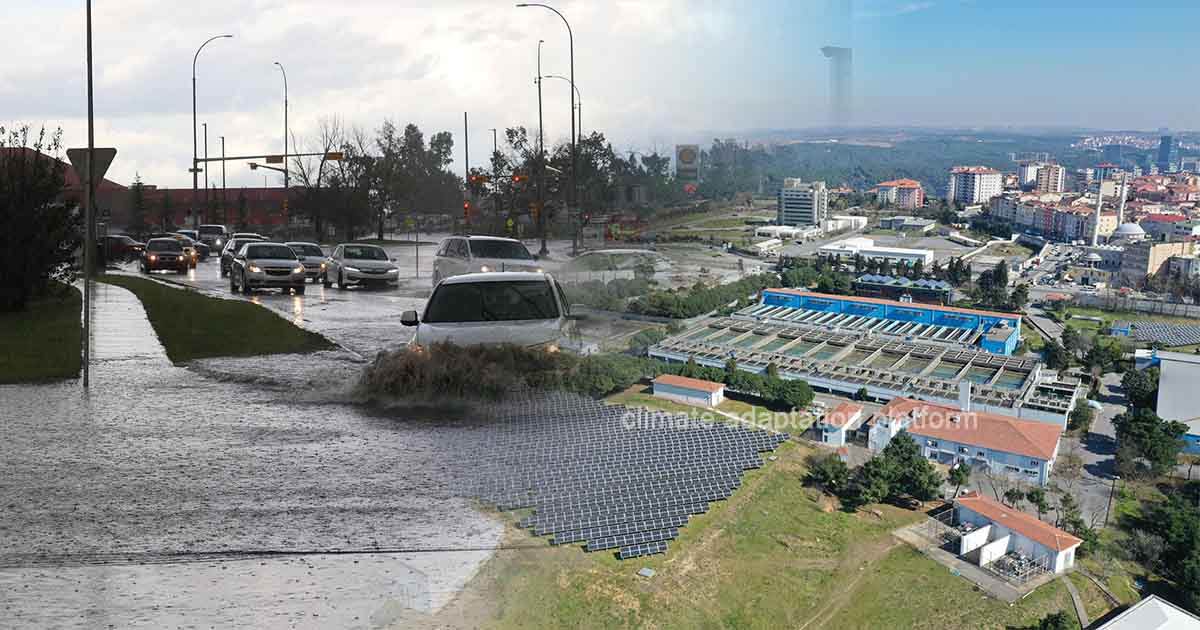
As climate change intensifies, through extreme weather events, rising sea levels, biodiversity loss, and growing food and water insecurity, climate adaptation is becoming increasingly essential.
Climate change adaptation refers to actions that reduce vulnerability to the current or projected impacts of climate change.
Because climate change affects everyone, both the public and private sectors must invest in resilience and take steps to reduce vulnerabilities. The University of Cambridge estimates that climate change could result in annual global economic losses exceeding USD 100 billion, with additional indirect costs from disrupted supply chains and other economic knock-on effects.
As a result, businesses are increasingly concerned about how climate change will affect operations, competitiveness, regulatory obligations, and long-term sustainability.
How the private sector can adapt
Adaptation Community highlights three primary ways in which the private sector can strengthen climate resilience:
- Climate-proofing value chains and operations to safeguard business continuity.
- Financing and investing in adaptation solutions.
- Providing adaptation solutions through products, services, and technologies that enhance resilience.
1. Strengthening internal resilience
The first role of the private sector is to enhance resilience across assets, operations, supply chains, and resources to ensure business continuity and long-term economic stability. This includes improving company buildings and infrastructure, upgrading production processes, safeguarding employee working conditions, and protecting storage facilities for supplies and goods.
Examples include installing power backups to ensure energy supply during storms, adopting water-saving technologies to address water scarcity, and using weatherproof storage to protect valuable assets from extreme weather.
2. Investing in adaptation solutions
The private sector can also help close the adaptation finance gap by investing in technologies, products, services, and projects related to climate resilience. However, several challenges exist. Many investors struggle to identify viable business opportunities because:
- Solution providers are not always clear about how their products contribute to climate adaptation
- There is no agreed-upon metric to quantify adaptation outcomes, unlike climate mitigation, where emissions reductions can be measured.
3. Providing adaptation products and services
Finally, companies can develop new adaptation solutions or scale up existing ones. Examples highlighted in the Adaptation Community article include:
- An Indian firm is developing drip irrigation systems to address water scarcity
- A chemical company creating heat-reflective pigments
- A Bangladeshi business manufacturing fibreglass fishing boats, resilient to turbulent conditions
- A Canadian SME producing renewable-energy-powered greenhouses capable of growing food year-round
The private sector’s contribution is crucial not only for business continuity but also for broader economic resilience. Strong collaboration with the public sector will be essential to building frameworks that support effective, long-term adaptation strategies.
Private adaptation investments in Europe are rising
A study published in Communications Earth & Environment in June 2025 examined how businesses across 28 European countries adapted to climate change between 2018 and 2022, covering five hazard types and 19 economic sectors.
The findings show that annual climate adaptation investment in the EU and the UK rose from €15.4 billion (USD 18 billion) in 2018 to €52.9 billion (USD 62 billion) in 2022, a 243% increase in five years. However, spending varies significantly between countries and sectors, which face different climate risks and impacts.
Climate hazards and adaptation spending patterns
According to data from the European Commission’s Risk Data Hub, 1,688 extreme weather events have been recorded since 2006, grouped into:
- Heatwaves: 40 events
- Droughts: 3
- Flooding: 549
- Wildfires: 151
- Other hazards: 945
Heatwave adaptation receives the highest share of investment across most countries, particularly in southern Europe, where measures such as air conditioning and ventilation are affordable and provide immediate benefits.
Countries spending less on heatwaves, particularly landlocked nations in Central and Eastern Europe, such as Austria, Slovakia, and Hungary, direct more resources toward flood management. Spending on wildfires (1.6–3.9%) and droughts (0.5–1.2%) remains low, mainly because the sectors most affected, agriculture and public services, are the main investors.
The interplay of public and private sector spending
The study also examined how public adaptation spending influences private investment. Public expenditure remained relatively stable across the 28 countries, ranging from 24.2% in Czechia (2021) to 26.6% in Lithuania (2018).
Overall, the analysis found a positive relationship between public and private adaptation spending: increases in public investment were accompanied by increases in private climate change adaptation (CCA) spending.
While adaptation spending remains modest, 0.15% to 0.92% of national GDP, it is growing rapidly at an annual rate of 30–37%.
Countries investing the most—and least
The Netherlands leads Europe in climate adaptation investment, averaging 0.58% of GDP, peaking at 0.92% in 2022. Greece, Croatia, and Italy also invest considerably due to high exposure to climate impacts.
Conversely, Ireland and Luxembourg invest the least, averaging below 0.1% of GDP over the five years.
Southern, Central, and Eastern European countries, many of which face higher projected climate damages and lower economic productivity, are likely to face increasing climate adaptation costs in the long term as climate risks intensify.
Learn more about the study: Private investments in climate change adaptation are increasing in Europe, although sectoral differences remain.
Sources:
New approaches to help businesses tackle climate change. (2020, February 20). University of Cambridge. Retrieved from https://www.cam.ac.uk/research/news/new-approaches-to-help-businesses-tackle-climate-change?mc_cid=554a012c44&mc_eid=323c29579c
Private Sector & Adaptation. (2019). Adaptation Community. Retrieved from https://www.adaptationcommunity.net/private-sector-adaptation/
Cortés Arbués, I., Chatzivasileiadis, T., Storm, S., Ivanova, O., & Filatova, T. (2025). Private investments in climate change adaptation are increasing in Europe, although sectoral differences remain. Communications Earth & Environment, 6(1), 1-12. https://doi.org/10.1038/s43247-025-02454-3
Leave a Reply