

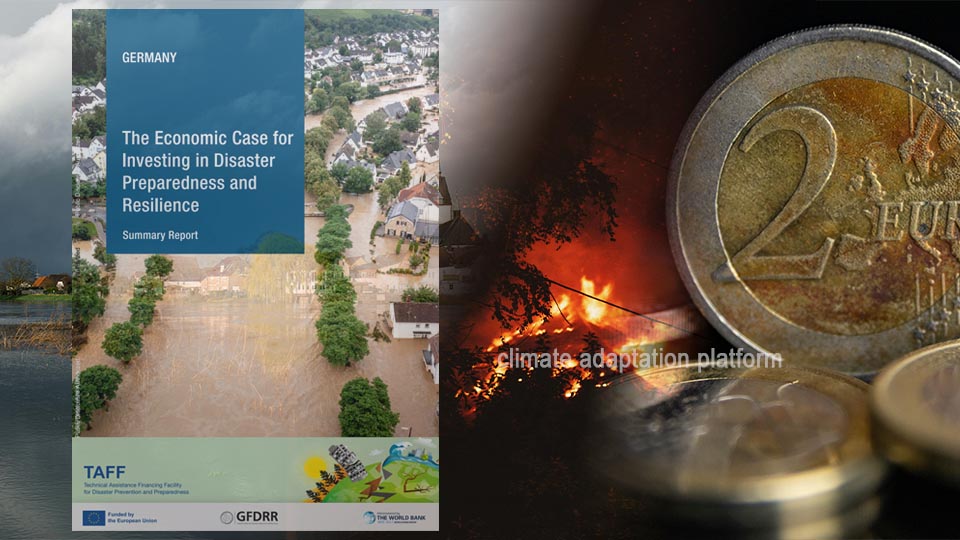
Extreme climate events in Germany are resulting in economic losses totalling billions of euros. The country faces three main climate risks: floods, heatwaves, and wildfires.
These events rarely occur in isolation and often lead to cascading impacts across various sectors, essential services, and infrastructure.
For instance, floods can damage fire stations or restrict access to hospitals, while wildfires may disrupt industrial facilities, hindering emergency response efforts. These interconnected risks amplify economic damage and disproportionately affect vulnerable populations.
A World Bank report, The Economic Case for Investing in Disaster Preparedness and Resilience, published in January 2026, highlights the urgent need to invest in disaster preparedness.
It estimates that extreme climate events caused economic losses exceeding €80 billion between 2018 and 2022, with projected losses rising to €280-€900 billion by 2050.
Compounding risks and infrastructure vulnerabilities
Germany has Europe’s largest wildland–industrial interface and a high concentration of hazardous industrial sites. This combination increases the risk of so-called natural–technological (Natech) hazards, where natural disasters trigger technological accidents.
Critical infrastructure, including transport networks and energy systems, remains highly exposed to flooding, landslides, and wildfires. These risks are not only economic concerns but are increasingly viewed as matters of national security.
The report also synthesises findings from several in-depth studies on urban flood exposure, heat adaptation, wildfire resilience, and multi-hazard early warning systems. It provides one of the first comprehensive reviews of benefit–cost ratios (BCRs) for multi-hazard resilience investments in Germany, while noting that further research is still needed.
The economic case for investing in resilience
The report presents strong evidence that investing in disaster preparedness and resilience delivers substantial returns. Across Europe, investments in disaster risk reduction (DRR) generate median economic benefits of €2-€10 for every €1 spent. In Germany, a multi-hazard investment portfolio could yield €2-€6 per €1 invested.
Targeted protection measures, such as safeguarding oil storage facilities from flooding, offer particularly high returns by preventing large-scale disruptions.
Meanwhile, non-structural measures, including improved regulatory frameworks and early warning systems, are highly cost-effective because they require relatively little capital. However, these approaches require coordination across multiple sectors and institutions.
For Natech risks, proactive planning, such as identifying potential escalation pathways through scenario analysis, can significantly reduce the risk of cascading failures, business interruptions, and environmental damage.
Overall, the report concludes that climate resilience investments not only reduce disaster losses but also deliver broader benefits, including improved social equity and long-term environmental sustainability.
Towards stronger multi-hazard preparedness
The report is structured around Germany’s key climate risks, floods, heatwaves, and wildfires, and examines current and future impacts, policy frameworks, and gaps in preparedness. It also identifies priority actions to strengthen climate resilience across multiple hazards.
Ultimately, the report aims to support policymakers in identifying the most urgent and cost-effective strategies to enhance national resilience.
Strengthening preparedness today will not only reduce the impacts of climate-related disasters but also improve the country’s ability to withstand a wide range of future shocks.
Source:
World Bank. 2026. Germany: The Economic Case for Investing in Disaster Preparedness and Resilience. Summary Report. Washington DC: World Bank Group. Retrieved from https://documents.worldbank.org/en/publication/documents-reports/documentdetail/099122325103032001
Leave a Reply