

Humans rely heavily on nature and the ecosystem services it provides. However, this reliance is increasingly contributing to the depletion and degradation of natural systems.
The concept of natural capital—referring to natural assets such as rivers, forests, soil, minerals, plants, and biodiversity—originates in economics and illustrates nature’s value in supporting human life and environmental well-being.
Natural capital is vital to economies, as it supplies essential resources such as food, water, fibre, minerals, and timber. It also provides important environmental services, including climate regulation, flood protection, and soil fertility maintenance.
However, the continued exploitation of natural resources, along with various human activities and extreme environmental events, is putting these valuable assets under significant stress.
Economic risks of nature loss
The degradation of natural capital poses significant risks to human health, societal stability, and economic performance.
A 2026 study, “Operationalising the concept of critical natural capital to understand and manage nature dependency risk“, highlights the scale of this risk: in the United Kingdom, nature loss could reduce GDP by up to 6%, while in Australia, nearly 50% of GDP is directly dependent on nature.
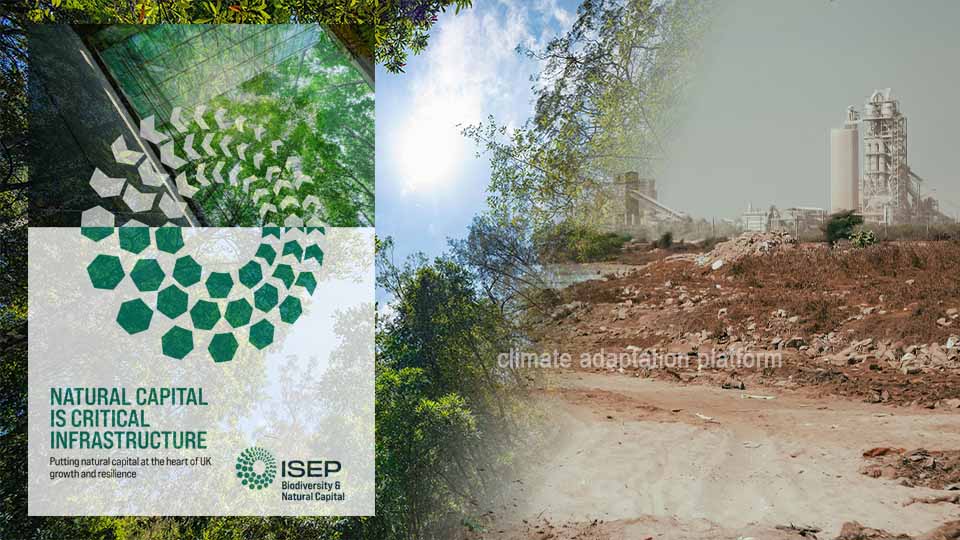
In response, the Institute of Sustainability and Environmental Professionals has published a policy paper titled “Natural Capital is Critical Infrastructure”, arguing that nature should be formally recognised as critical national infrastructure.
The report emphasises that traditional infrastructure—such as transport networks, power stations, and digital systems—relies fundamentally on healthy ecosystems to function effectively.
Despite this, natural capital is not yet formally recognised as critical infrastructure in the UK.
According to the report, the loss of natural capital affects economic resilience, increases operational costs, and threatens access to essential resources. Several UK institutions have quantified both the value of nature and the risks associated with its degradation:
- The Office for National Statistics estimates that UK ecosystem services are worth £1.8 trillion, equivalent to around 72% of GDP.
- The Green Finance Institute warns that environmental degradation could result in GDP losses of 6–12% by the 2030s.
- Natural England highlights that environmental decline threatens industrial productivity and resilience to climate and economic shocks.
For context, the 2008 financial crisis reduced GDP by around 5%, while the COVID-19 pandemic led to an 11% decline in 2020—illustrating the scale of potential impacts from environmental degradation.
Encouragingly, investment in nature-based solutions can deliver strong returns. The report notes that every £1 invested in such solutions can generate up to £3 in social and economic benefits.
Policy recommendations for a nature-based economy
The report brings together insights from experts across infrastructure, energy, water, transport, and finance sectors.
It concludes that the degradation of natural capital could significantly disrupt essential services, economic stability, and even national security.
To address these challenges and unlock the economic potential of nature, the report outlines six key policy recommendations:
- Recognise natural capital as critical infrastructure: Formally classify it as essential to national performance and economic growth.
- Create a Strategic Nature Network (SNN): Establish a major national infrastructure programme to direct investment where it delivers the greatest ecological and economic benefits.
- Integrate nature into planning frameworks: Embed the SNN into national policy and spatial planning systems to ensure consistent reporting and measurable outcomes.
- Mandate nature-related financial disclosures: Require key sectors and public bodies to account for nature in investment decisions.
- Establish a Natural Infrastructure Investment Fund: Support early-stage nature recovery projects and attract private investment.
- Develop training and guidance: Equip decision-makers with the tools to apply natural capital approaches effectively.
By embedding natural capital into infrastructure planning and economic decision-making, policymakers can strengthen resilience, drive sustainable growth, and safeguard the ecosystems that underpin society.
Read the ISEP report to learn more: Natural Capital is Critical Infrastructure. Putting natural capital at the heart of UK growth and resilience.
Source:
Report calls for UK to designate natural capital as critical national infrastructure to strengthen growth and resilience. (2026, January 8). Institute of Sustainability & Environmental Professionals. Retrieved from https://www.isepglobal.org/resources/news/2026/january/report-calls-for-uk-to-designate-natural-capital-as-critical-national-infrastructure-to-strengthen-growth-and-resilience/
Bradley, C., Clement, S., Vardon, M., Milligan, B., & Kagohashi, K. (2026). Operationalising the concept of critical natural capital to understand and manage nature dependency risk. Ecosystem Services, 77, 101799. https://doi.org/10.1016/j.ecoser.2025.101799
Nichols, J., Wilson, L., & Seville, O. (2026, February 26). Reframing Resilience: Natural Capital as Critical Infrastructure. Jacobs. Retrieved from https://www.jacobs.com/newsroom/news/reframing-resilience-natural-capital-critical-infrastructure
Leave a Reply