

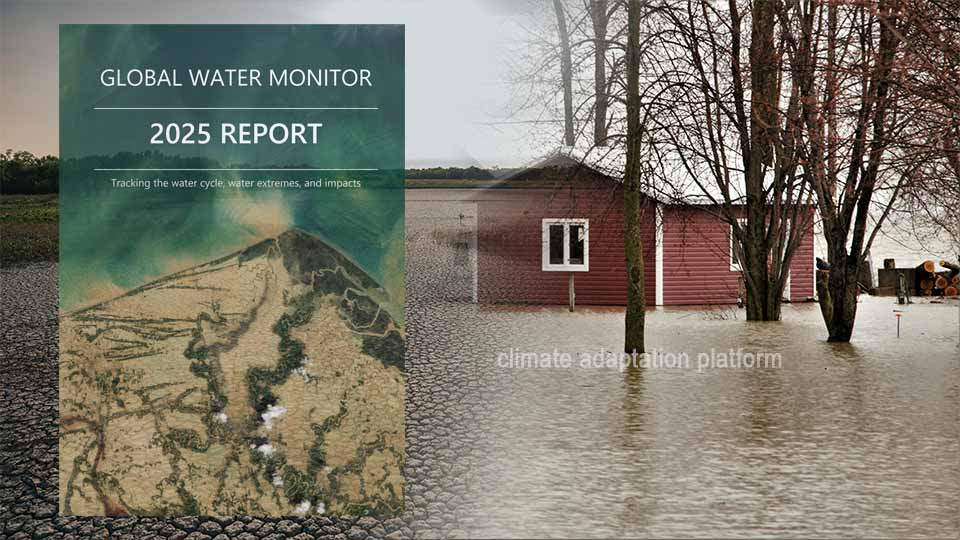
The Global Water Monitor 2025 is the third and latest edition of the annual report led by researchers at the Australian National University, in collaboration with international partners.
The report updates previous editions by summarising the status of the global water cycle in 2025, highlighting key trends, and analysing significant hydrological events using satellite observations and ground-based measurements.
It includes updated metrics on global rainfall, temperature, air humidity, river flows, and water storage in lakes, soils, and underground reservoirs. The report also provides insights into extreme rainfall and temperature events.
Its core message is clear. As the planet warms, water-related challenges are intensifying year after year.
Rising extremes and shifting water patterns
The report states that 2025 was the third hottest year on record, characterised by significant hydrological extremes. The global water cycle has shown increasing variability, with rapid transitions between very wet and very dry conditions.
Regions that previously experienced minimal water risks are now facing heightened exposure to floods, droughts, and extreme heat.
Ongoing warming is altering how water moves, is stored, and is exchanged between the atmosphere, land, and oceans. These changes are intensifying extreme events and their cascading impacts on ecosystems, economies, and communities.
The study draws on a wide range of indicators, including precipitation, air temperature (both maximum and minimum), humidity, soil moisture, surface water, river flows, lake and reservoir volumes, vegetation condition, and terrestrial water storage. Satellite data are calibrated with ground observations to improve accuracy.
Key findings from the report
The report highlights several important trends:
- Precipitation: Overall rainfall over land was close to average, but record-dry months increased significantly, rising by 9.7% per decade.
- Extreme rainfall: Maximum daily rainfall and the frequency of broken rainfall records are increasing by 2.3% and 4.5% per decade, respectively.
- Temperature: Air temperatures over land ranked as the third-highest on record. Record-warm months occurred 3.5 times more often than the baseline average.
- Heat extremes: Maximum temperatures were 0.71°C above the 1995–2005 baseline, with hot days 22% more frequent.
- Cold extremes: Minimum temperatures are rising, while frost days have declined by 6.3%.
- Humidity: Air humidity continues to decline globally, with record-low levels occurring twice as often as in the baseline period.
- Soil moisture: Strong regional contrasts persist, with drought conditions in Europe and Siberia, and wetter conditions in parts of Asia and South America.
- Vegetation: Vegetation greenness increased by 7.6% compared with the 2001–2005 average.
- Surface water: Surface water extent remained near average, but record-high values are becoming more frequent.
- River flows: River flows were 10.6% above the baseline, particularly in Africa and South America.
- Lakes and reservoirs: Volumes remained close to average overall, with regional extremes of both highs and lows.
- Water storage: Terrestrial water storage continues to decline globally, despite regional increases in parts of Africa.
A connected web of global water disasters
The report emphasises that disasters worldwide are interconnected through the global water cycle. Events that may appear isolated are, in fact, part of a broader, increasingly unstable system.
Highlighted examples include wildfires in Los Angeles that revealed vulnerabilities in the water supply, flash floods in Queensland linked to ex-tropical cyclones, glacial lake outburst floods in the Himalayas, rare equatorial cyclone flooding in Sumatra, and consecutive typhoons in the Philippines. These events illustrate how disruptions in the water cycle are occurring across various regions and climates.
Below is the graph from the report showing where the world’s major water-related disasters occurred, the types of disasters (flooding, drought, and heatwave), and the time of year they occurred.
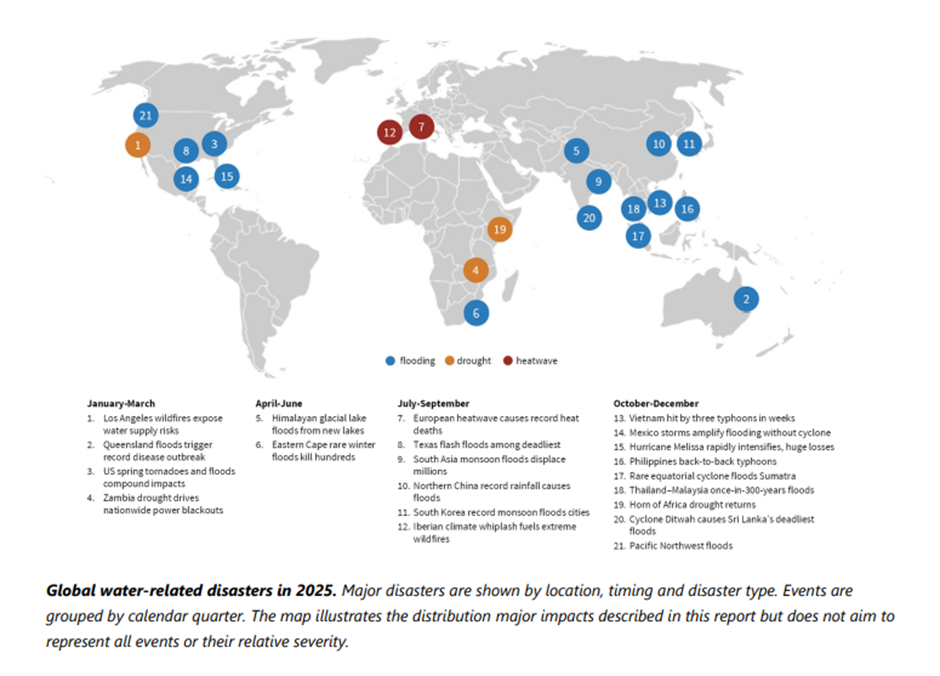
In 2025 alone, water-related disasters—including floods, droughts, heatwaves, tropical cyclones, and wildfires—caused nearly 5,000 deaths, displaced around 8 million people, and resulted in global economic losses exceeding US$360 billion.
Outlook for 2026
Looking ahead, the Global Water Monitor report warns of continued risks. Below-average soil moisture, vegetation health, and water storage in regions such as the Mediterranean, the Horn of Africa, Brazil, and parts of Central Asia point to an increased likelihood of drought in 2026.
Conversely, regions including the Sahel, South Africa, northern Australia, and much of Asia face elevated risks of flooding and landslides due to excessive rainfall.
With ongoing climate change expected to drive higher global temperatures, the likelihood of heatwaves, bushfires, intense storms, and rapid-onset floods and droughts is set to increase worldwide.
Source:
Van Dijk, A.I.J.M., H.E. Beck, E. Boergens, R.A.M. de Jeu, W.A. Dorigo, C. Edirisinghe, E. Forootan, E. Guo, A. Güntner, J. Haas, J. Hou, S. Mo, W. Preimesberger, J. Rahman, P. Rozas Larraondo (2026) Global Water Monitor, 2025 Report. Published by Global Water Monitor Consortium, available at www.globalwater.online
Van Dijk, A. (2026, January 13). What is the global water cycle and how is it amplifying climate disasters? The Conversation. Retrieved from https://theconversation.com/what-is-the-global-water-cycle-and-how-is-it-amplifying-climate-disasters-272806
Leave a Reply