

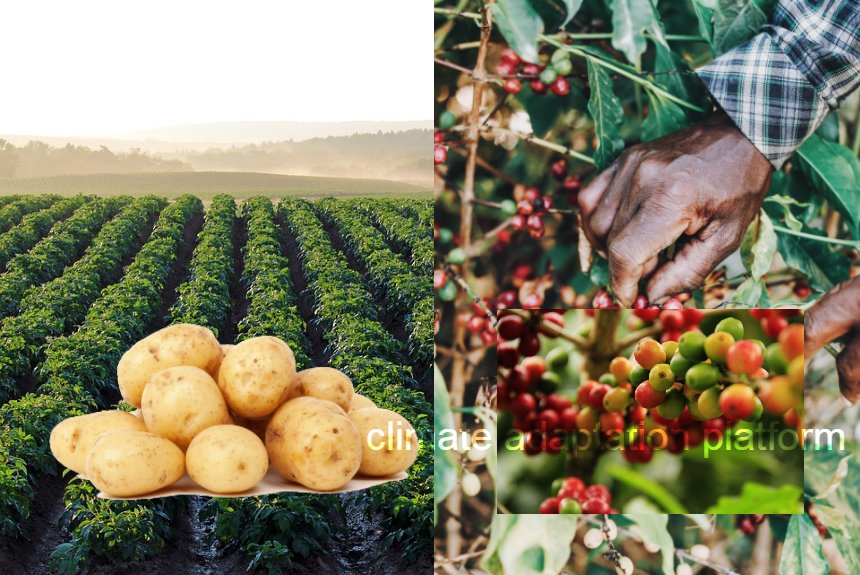
Some studies mention advantages of climate change, such as longer planting and growing seasons. Some colder regions will experience an earlier spring onset and a longer warm season (Herring, 2020).
A longer growing season may benefit farmers, but some crops, such as potatoes and coffee, will likely be affected. Climate adaptation is needed for these two essential crops to maintain their quality and yield.
Warming temperatures and an extended growing season can lead to quality problems and diseases in potatoes grown in Maine and other states. Heavier rainfall events or lingering conditions can also affect potato quality (Researchers try producing, 2021).
Researchers at the University of Maine are trying to develop potatoes that better cope with warming temperatures and climate change. Warming temperatures can also spread crop diseases and pests like aphids. Pest management specialists consider breeding small variants of a plant, such as a hairier-leaved potato, to deter pests from the plant. Warming temperatures and an extended growing season can lead to quality problems and diseases in potatoes grown in Maine and other states. Heavier rainfall events or lingering conditions can also affect potato quality (Researchers try producing, 2021).
Breeding such characteristics into potatoes is long and takes years to produce a new potato variety. Nonetheless, the breeding process is underway, and breeders are doing a research testing phase at various sites in the United States.
Coffee is another crop at risk from climate change. A study published in Frontiers magazine finds that climate change can alter the taste and aroma of coffee and its overall quality. The authors reveal that coffee quality is affected by environmental changes driven by climate change, and that many coffee-producing regions already experiencing changing climate conditions will produce coffee with different smell and taste.
The study reviewed 73 articles to investigate the environmental factors linked to climate change and climate adaptation practices and their effects on coffee quality. Regions that grow well-known coffee varieties such as Coffea arabica and Coffea canephora are highly dependent on these crops for their economies and livelihoods. According to the study, “While variation was found between studies, the findings highlight that coffee quality is vulnerable to changes in light exposure, altitude, water stress, temperature, carbon dioxide, and nutrient management.”
The study identifies two trends in the literature review. First, coffee grown at higher altitudes has better taste and aroma; second, increased light exposure can reduce coffee’s taste and aroma.
Preventing decline in coffee quality and sensory attributes will require climate adaptation.
The researchers identified promising climate adaptation solutions, including shade management through agroforestry, selection of climate-resilient coffee species, integrated pest management, and soil nutrient management, to offset the impacts of climate change.
Climate adaptation initiatives can help farmers and the coffee sector build resilience against climate change and protect the quality and profitability of this precious crop.
Click the link to read the entire study:
Sources
Researchers try producing potato resistant to climate change. (2021, November 29). ABC News. Retrieved from https://abcnews.go.com/Business/wireStory/researchers-producing-potato-resistant-climate-change-81430456
Ho, Sally. (2021, November 10). Coffee Won’t Taste and Smell The Same Due To Climate Change, Study Finds. Green Queen. Retrieved from https://www.greenqueen.com.hk/coffee-climate-change-study/
Herring, D. (2020, October 29). Are there positive benefits from global warming? NOAA Climate.gov. Retrieved from https://www.climate.gov/news-features/climate-qa/are-there-positive-benefits-global-warming
Ahmed S, Brinkley S, Smith E, Sela A, Theisen M, Thibodeau C, Warne T, Anderson E, Van Dusen N, Giuliano P, Ionescu KE and Cash SB (2021) Climate Change and Coffee Quality: Systematic Review on the Effects of Environmental and Management Variation on Secondary Metabolites and Sensory Attributes of Coffea arabica and Coffea canephora. Front. Plant Sci. 12:708013. doi: 10.3389/fpls.2021.708013
Leave a Reply